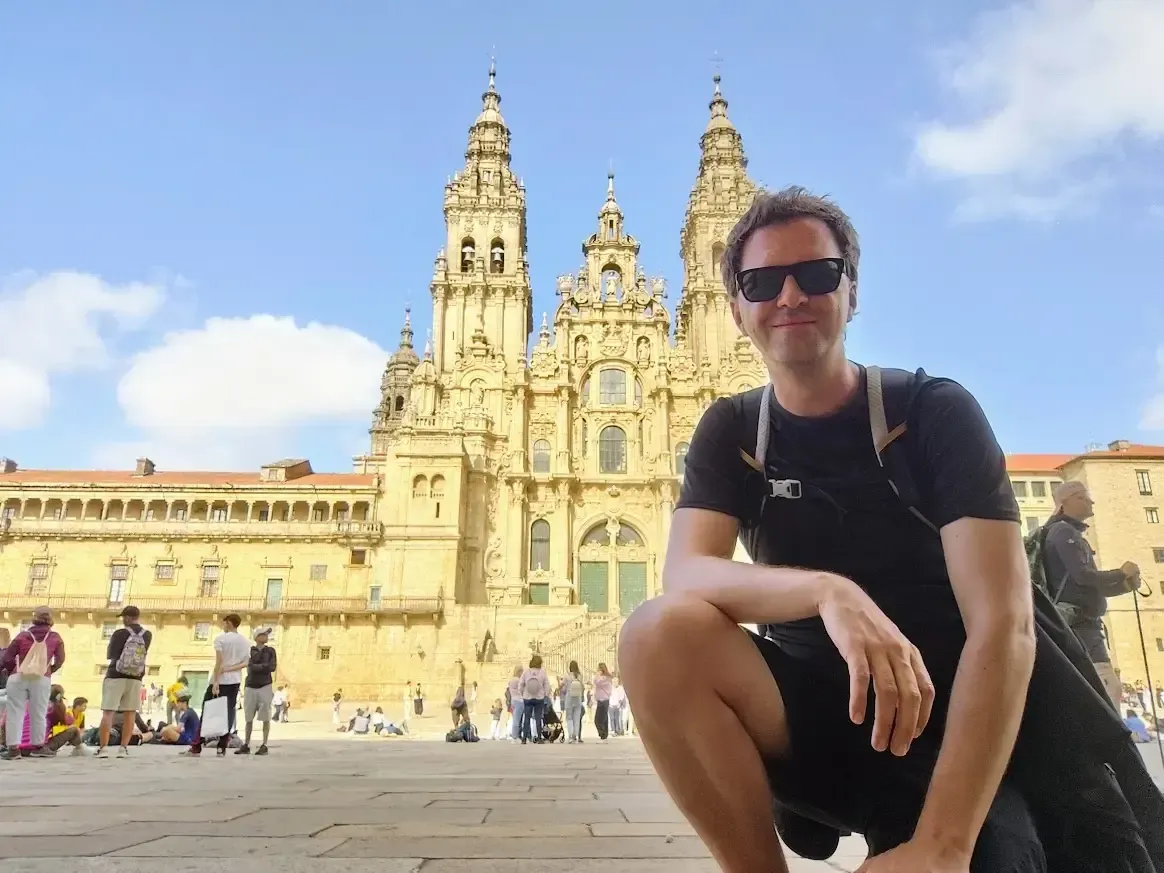
If you are thinking about walking the Camino Portugués Coastal Route, this guide is my own experience of walking it in 2025, with the practical tips I wish I had known before the trip.
I walked it from Baiona, in 6 stages and about 128 km. If you would rather start from Porto or from Tui, which is what most people do, further down I explain what the Camino Portugués from Porto and from Tui looks like, where it goes and where it joins my route.
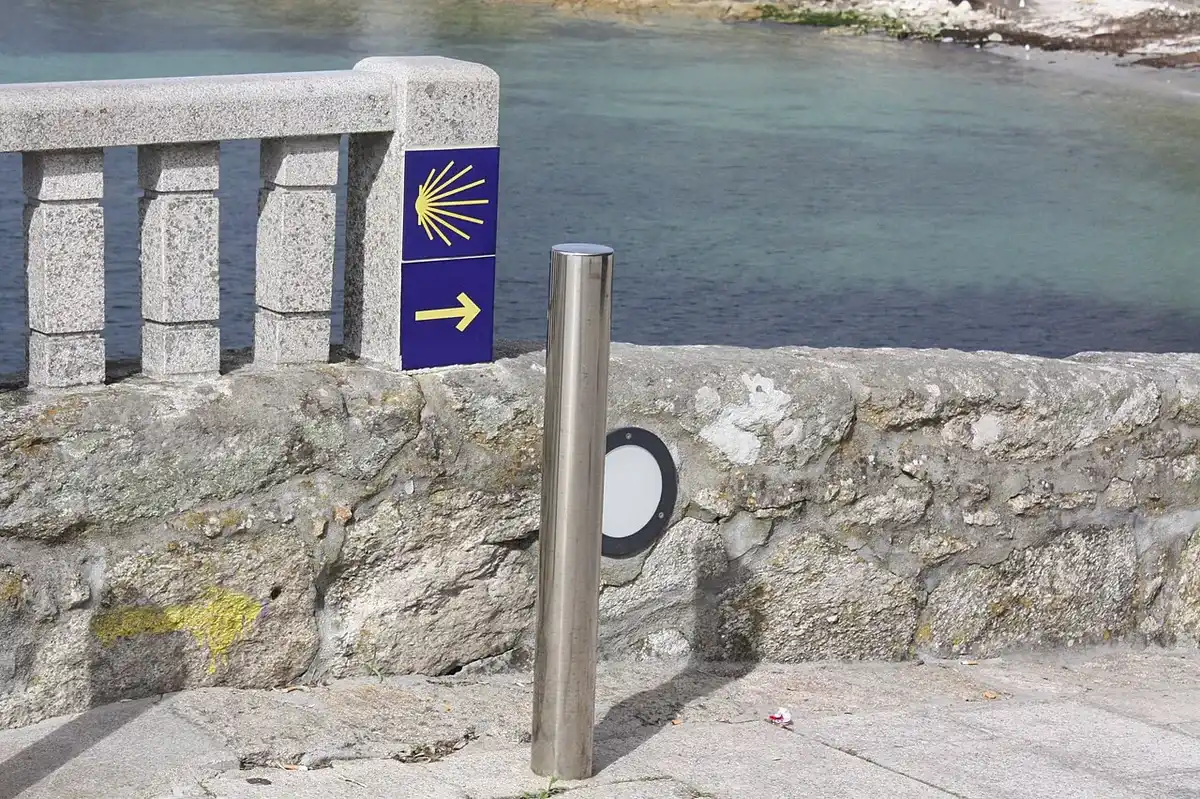
The 6 stages of the Camino Portugués coastal route at a glance
I walked 6 stages from Baiona to Santiago, plus an arrival day and another one to see Santiago without a backpack. This is the full route, with what my watch recorded, the official kilometres and the elevation of each stage:
| Stage | Route | My watch | Official | Elevation |
|---|---|---|---|---|
| 1 | Baiona → Vigo | 27 km · 6 h 46 | 26.8 km | +128 / -104 m |
| 2 | Vigo → Redondela | 24 km · 5 h 41 | 15.4 km | +213 / -227 m |
| 3 | Redondela → Pontevedra | 22 km · 5 h 51 | 18.2 km | +401 / -380 m |
| 4 | Pontevedra → Caldas de Reis | 24 km · 5 h 48 | 22.9 km | +218 / -222 m |
| 5 | Caldas de Reis → Padrón | 21 km · 5 h 32 | 19 km | +187 / -209 m |
| 6 | Padrón → Santiago | 29 km · 7 h 18 | 25 km | +405 / -157 m |
In total I walked 147 km in almost 37 hours on the clock. One clarification about the distance, because it tends to confuse people: the official route from Baiona to Santiago is about 128 km[1][2], but my watch recorded 147. The difference is the coastal variants I took whenever the weather was good, the detours (the A Barosa waterfalls, the loop out to Cesantes) and wandering around each town at the end of the stage. If you go straight through, count on the 128. The elevation figures are Gronze's[23]: as you can see, no stage climbs more than 405 metres.
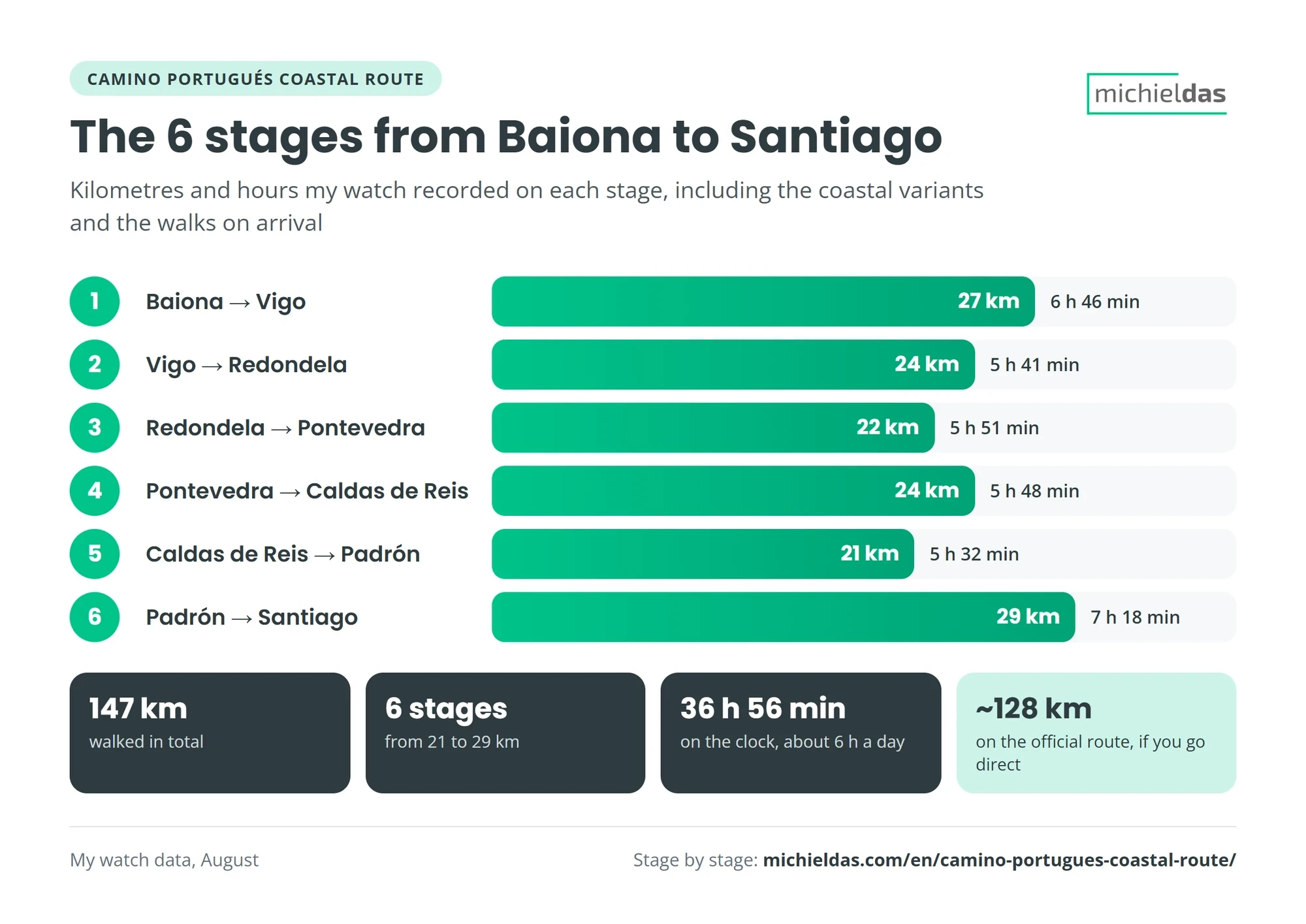
Further down you have each stage with its stops, photos and map, and after the stages, the route ready to print.
Do you need to be fit to walk the Camino Portugués?
Twenty years ago a university classmate of mine walked the Camino, and that story stayed with me. When I finally sat down to decide, I compared several routes and dates with two clear criteria:
- I wanted a good experience in late August (mild weather, no extremes)
- And at the same time, I wanted to avoid the crowded routes
That is why I chose the Portuguese Coastal Route, starting in Baiona and reaching Santiago in six days (with stops in Vigo, Redondela/Cesantes, Pontevedra, Caldas de Reis and Padrón). It is a very varied route (sea, beaches, villages and forest sections) and far less busy than the alternatives. As for fitness: with official stages of 15 to 27 km and less than 405 metres of climbing a day, you do not need to be an athlete, but you do need to have walked for several hours in a row before.
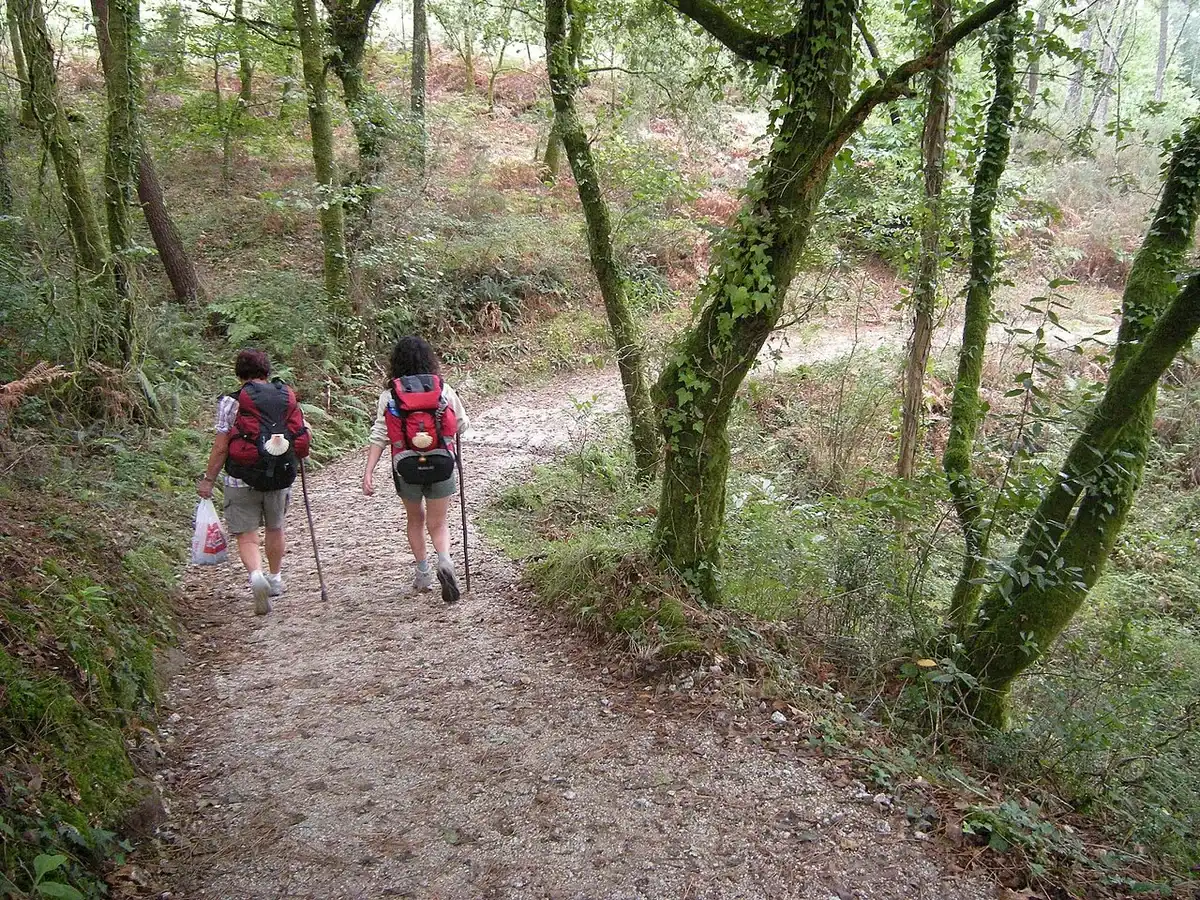
What kind of traveller am I, and how did I approach the Camino?
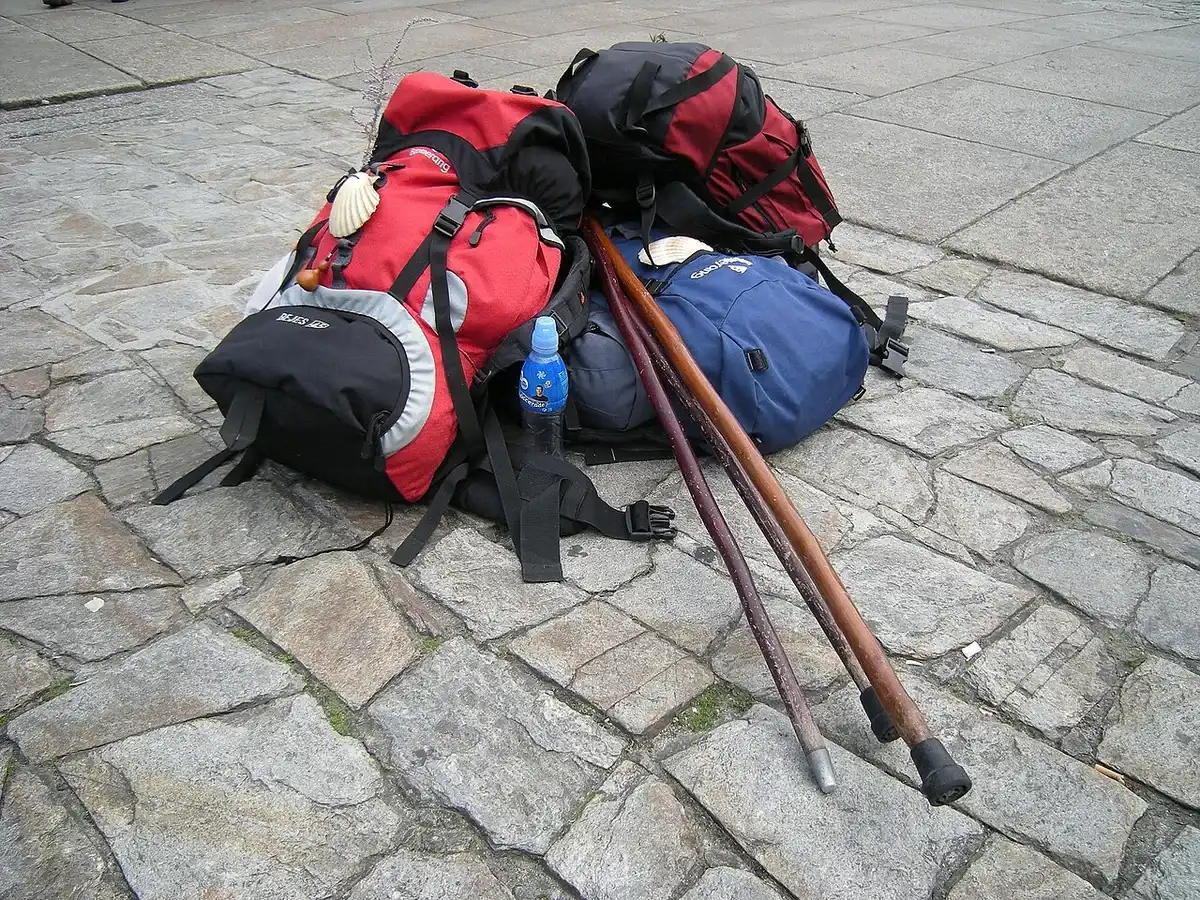
- Minimalist: I walked with a 4.5 kg backpack. Travelling light let me enjoy it more, move without pain and not wrestle with luggage at the end of every stage.
- Sleep first: I am a light sleeper and I need to sleep well, so I did not use albergues. I went for guesthouses, pensiones and apartments, and I booked in advance (mostly on Booking) so I would not have to improvise at the end of the day, and because many albergues do not take reservations.
- Planning: I had the stages defined, the accommodation locked in, and some slack for small, pretty detours (waterfalls before Caldas de Reis, for instance, or coastal stretches off the official route when the weather allowed).
- Payments: in Galicia you sometimes need cash (city buses, small bars). Carrying coins saved me trouble.
What clothes did I take?
My rule was light layers, quick-drying, few items. You do not need much, but you do need the right things:
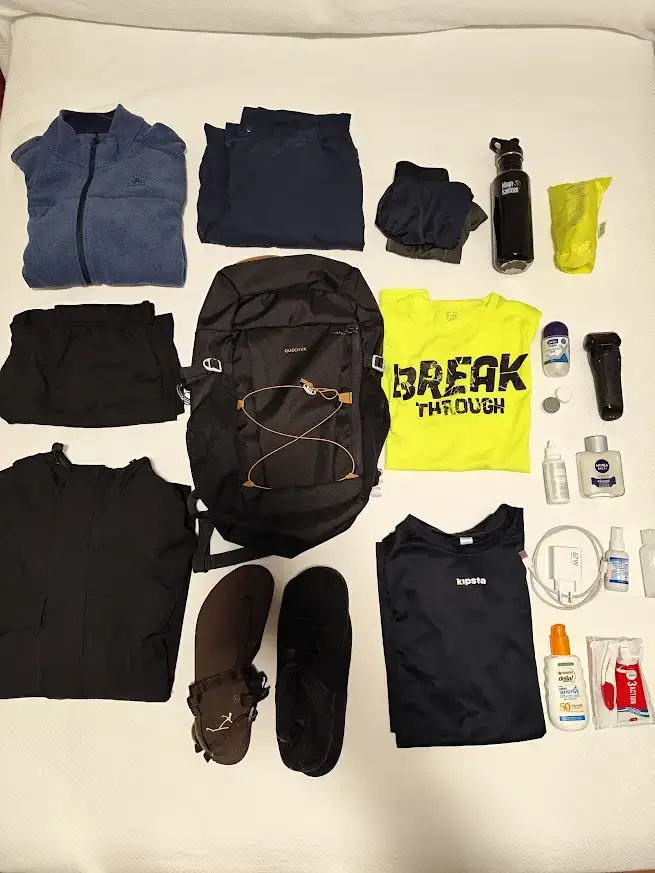
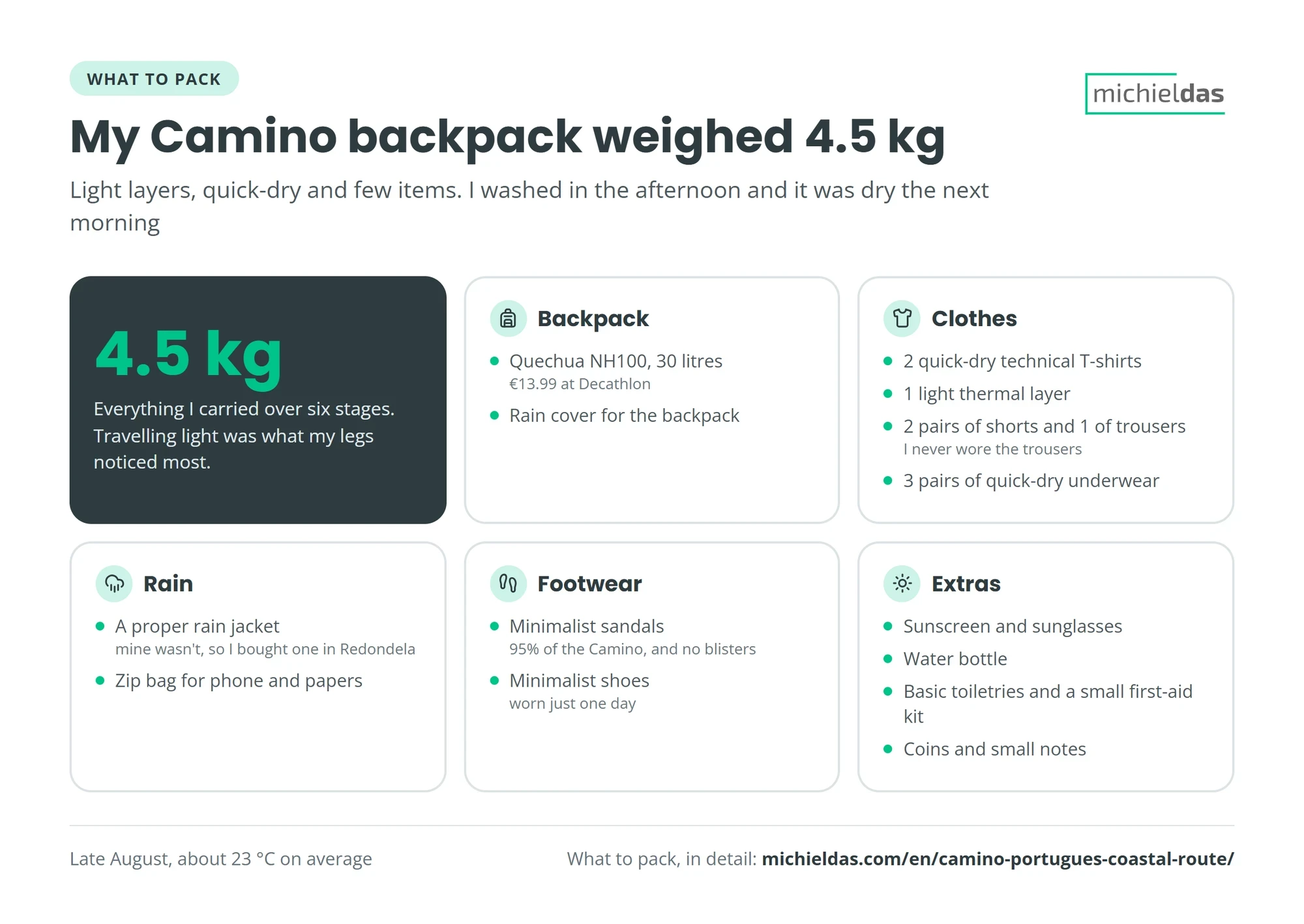
- Backpack: I bought this 30 L Quechua NH100 at Decathlon for €13.99. Very light, and it holds a surprising amount.
- Upper body: 2 quick-drying technical t-shirts (I rotated them, washing one in the afternoon and drying it overnight) and a light thermal layer for the cool early hours.
- Lower body: 2 pairs of technical walking shorts, and one pair of long trousers in case it got chilly (I did not wear them a single day).
- Underwear: 3 pairs of quick-drying briefs.
- Rain gear: in Galicia the rain appears and disappears. Careful: the jacket I started with was not actually waterproof and I had to buy a rain jacket in Redondela. If I did it again, I would set off with a good one from day 1. I would also recommend a waterproof cover for the backpack (I bought this one at Decathlon).
- Footwear: I applied the minimalist approach to footwear too, and took a pair of minimalist sandals (these Pies Sucios huaraches) and a pair of minimalist shoes (which I only wore one day). I walked 95% of the Camino in the sandals, some sections even barefoot, because at an average of ~24 ºC the weather was perfect, and that way I avoided blisters. Nothing hurt, and my feet stayed much cooler than they would have in closed shoes.
- Small extras: sunscreen (bear in mind you will be walking 5–6 hours a day, and you can burn even on a cloudy day), toothpaste, deodorant, contact lens solution, a water bottle (essential day to day), sunglasses, a zip bag for documents and phone if it rains, and a small first-aid kit.
Which shoes should you take if you are not going minimalist?
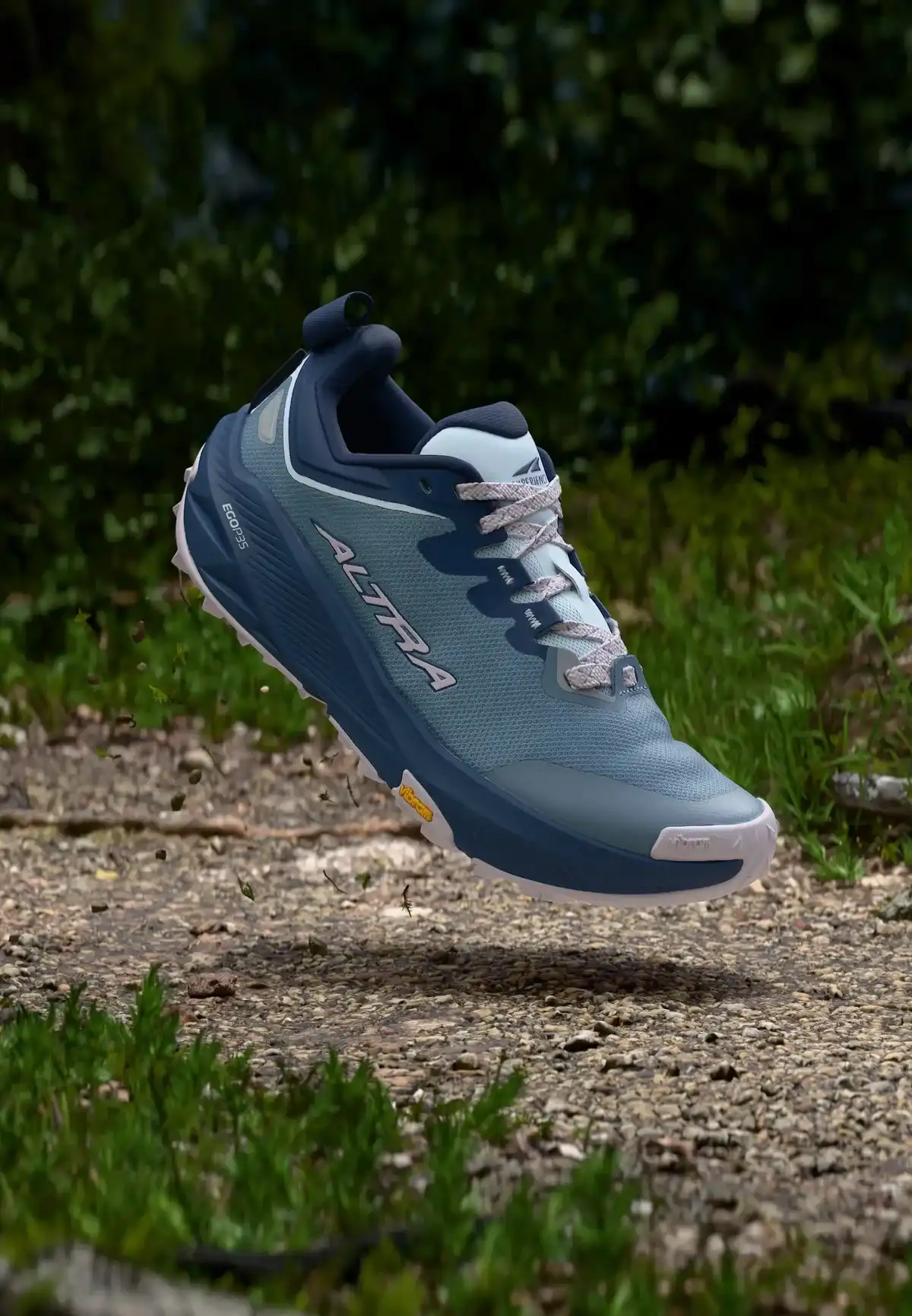
Most pilgrims walk in trail running shoes or light hiking shoes, not mountain boots. Three brands come up again and again on the forums, each with its own strength:
- Hoka: a thick sole with lots of cushioning and little weight. The choice for people who want to protect their knees and feet on long stages with plenty of tarmac, like the walk into Vigo or the final stretch to Santiago.
- Altra: a wide, foot-shaped toe box and a flat sole, with no drop between heel and toes. Your toes spread as you step, and it is the closest thing to my sandals, but with cushioning.
- Merrell: the classic hiking shoe (the Moab), sturdy with good grip, and available in a waterproof version for Galician rain.


Why this route (and why August)?
- Weather and season: late August in Galicia usually means around 23 ºC, intermittent sun and short showers. For me it was perfect: I could alternate beaches and forests without stifling heat.
- Varied scenery: I did not want to be in forest the whole time, or in villages the whole time. Here you get coastline, seafront promenades, quiet villages and green stretches. On top of that, the route is flat and not technically difficult.
- Moderate traffic: I noticed far fewer people than on the more famous routes. That let me walk at my own pace, think, and still find services when I needed them.
Is it better to hire an agency, or to organise it yourself?
While planning my route, I asked Santiago Ways and Orbis Ways for a quote (they belong to the same group, by the way).
The upside: they take the searching and booking off your hands (accommodation, meals and so on) and it is extremely convenient if you are short on time or the logistics stress you out.
My reality: the price they quoted me for accommodation and meals alone came to the same as my entire trip cost me on my own, flights included. So organising it myself was cheaper, more flexible and, honestly, more fun. If you do not want to plan anything or you are travelling in peak season, an agency can make sense; otherwise, with advance bookings and flexible cancellation, DIY wins.
How much does the Portuguese Coastal Way cost? My real budget
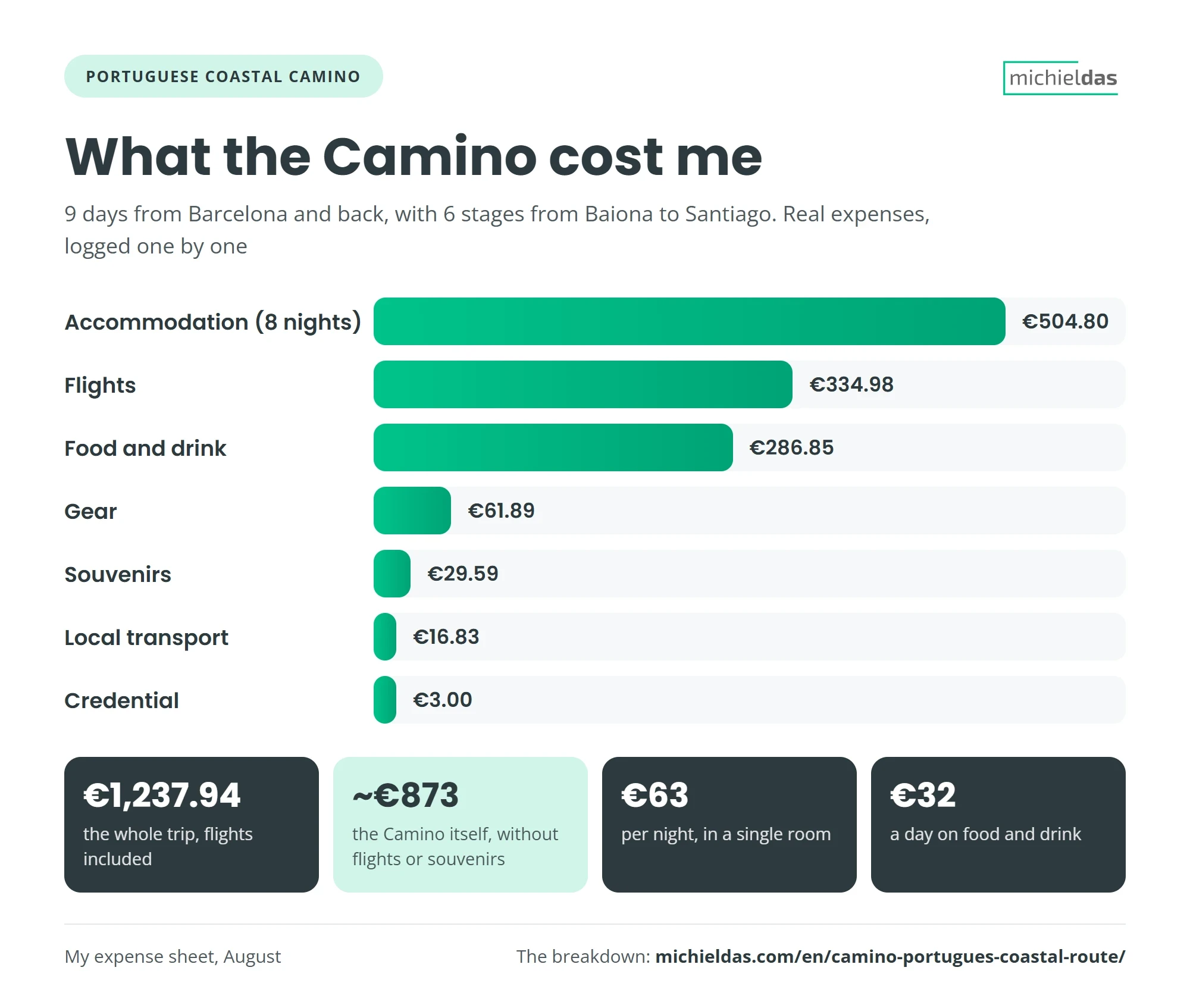
The whole trip, 9 days from Barcelona back to Barcelona in late August 2025, cost me €1,237.94. I logged every expense in a spreadsheet, so these are the real figures:
| Item | Cost |
|---|---|
| Accommodation (8 nights) | €504.80 |
| Flights | €334.98 |
| Food and drink | €286.85 |
| Gear | €61.89 |
| Souvenirs and gifts | €29.59 |
| Local transport | €16.83 |
| Credencial | €3.00 |
| Total | €1,237.94 |
What is behind each item:
- Accommodation: about €63 a night, always in a single room.
- Flights: Barcelona → Vigo (€144.99) and Santiago → Barcelona (€189.99).
- Food and drink: about €32 a day, mixing bars, restaurants and supermarkets.
- Gear: the backpack, the rain cover and a few other things from Decathlon, plus the rain jacket I bought in Redondela.
- Local transport: the Aerobús in Barcelona and the buses in Vigo and to Baiona.
- Souvenirs and gifts: prints, a magnet, a cake and a present.
Without flights and souvenirs, the Camino itself (accommodation, food, gear and transport) came to about €873. Two things that can bring that down a lot:
- Accommodation is the biggest cost. I always slept in guesthouses, hotels and apartments, in a single room, because resting properly was my priority and I am a light sleeper. A pilgrim albergue is much cheaper, in exchange for sharing a dorm and the fact that many do not take reservations.
- Book your flights early. I bought mine fairly last-minute and it shows: flights are more than a quarter of the total. Booking ahead brings the price down a lot, and on the last day I explain why buying the two legs separately worked out better for me.
How many days do you need, and where to start: Porto, Baiona or Vigo?
The short answer: from Baiona it is 6 walking days, which is what I chose. But the Camino Portugués Coastal Route can be started at several points, and everything else follows from that:
And in 5 days? It can be done, in two ways: starting in Vigo (the cleaner option) or merging two of the short stages. I would not merge: my longest stage was 29 km and it was already hard at the end, so adding Caldas–Padrón to another one leaves you a day of more than 40 km. Before compressing, trim the beginning.
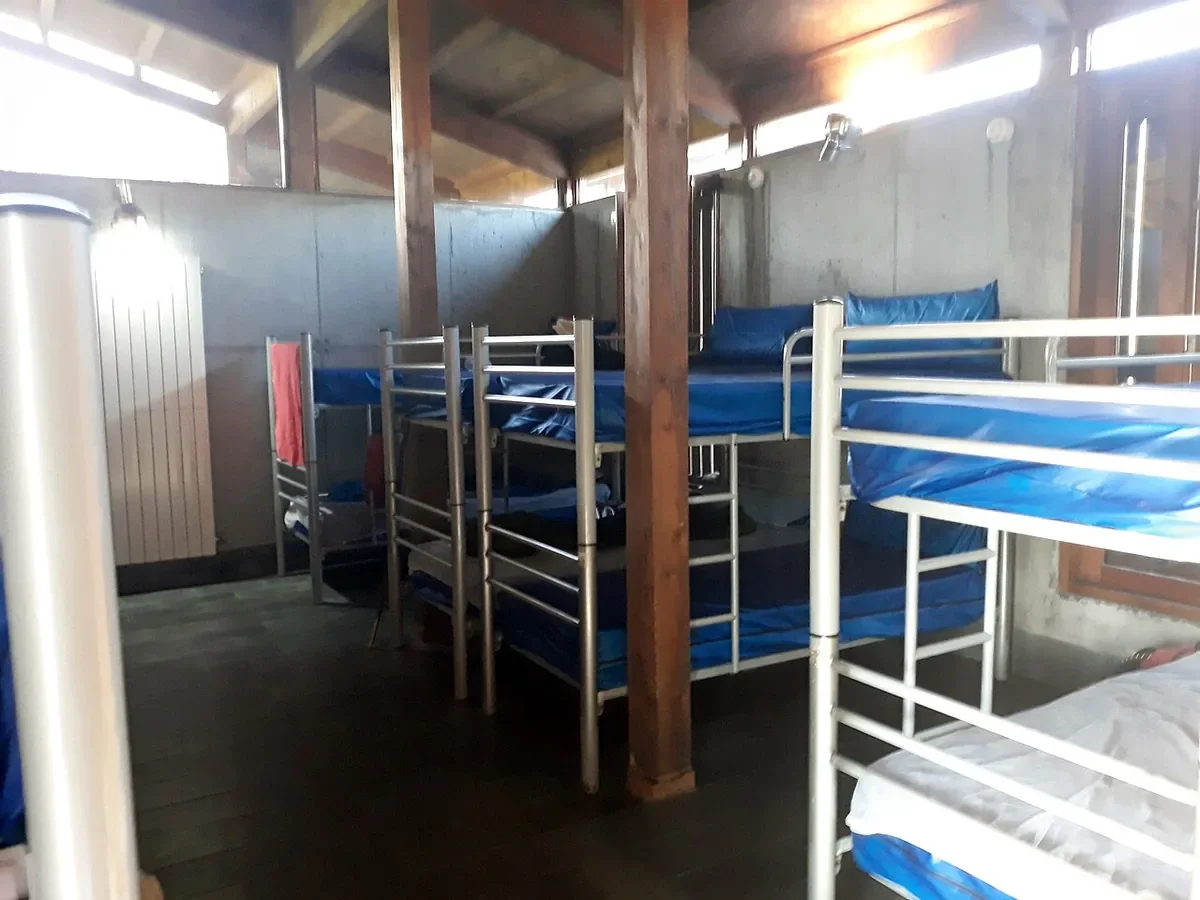
What about the albergues? There are albergues along the whole route, but I did not use a single one: I am a light sleeper and I need to rest properly, so I went for pensiones, guesthouses and apartments booked in advance. If you are going to use albergues, bear in mind that many do not take reservations and that the ones in Redondela fill up early, so either you arrive early or you carry on to the next town (that is what took me to Cesantes, where I ended up in a room facing the ría).
What is the Pilgrim Credential and how does it work?
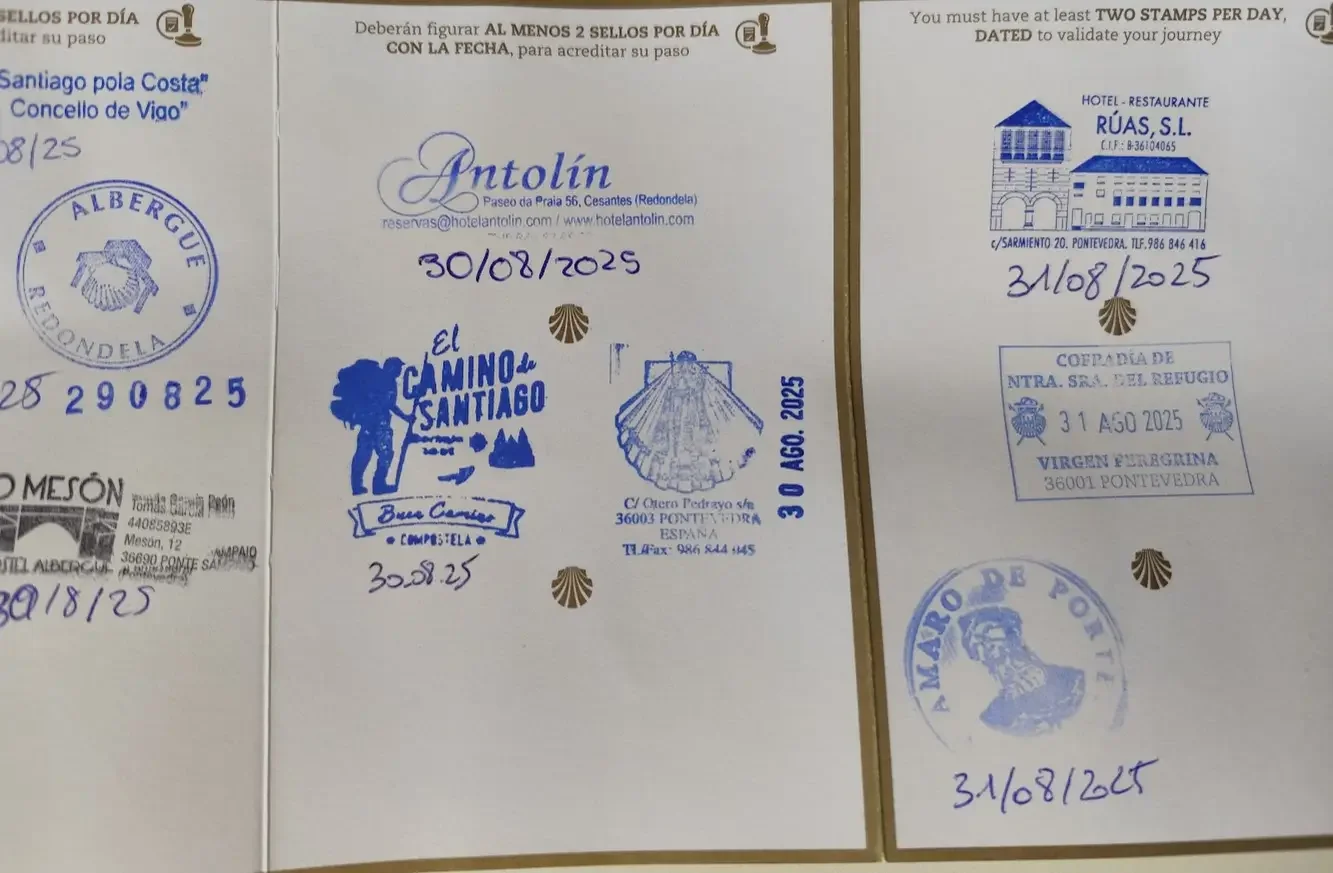
The Pilgrim Credential is your Camino passport: you collect stamps along the way and, on arriving in Santiago, you can request the Compostela[6]. The tradition is more than a thousand years old: since the Middle Ages, pilgrims from all over Europe have walked the Way of St James to Santiago. Today the Friends of the Camino associations look after the waymarking and many of the albergues.
To get it you need to walk at least 100 km (or 200 km by bike)[4]. In practice, you will be asked for two stamps a day over the last 100 km; I collected at least three every day for simplicity (one in the morning at my accommodation and one at midday in a bar, church or tourist office).
I bought my credencial in Baiona (Hotel Anunciada, for €3). On the first page there is a QR code you have to scan, which asks for your basic details (name, where you are starting from, and so on). Once filled in, it gives you an alphanumeric code that you need to write down, and that is the same code you give in Santiago de Compostela at the Pilgrim Office: you show your code, they check your stamps, and they hand you the Compostela.
Do you need to book accommodation in advance? How I planned each stage
I organised everything myself through Booking, because it is the simplest option: accommodation with flexible cancellation, everything centralised in the app (addresses, check-in, last-minute changes) and zero stress at the end of each stage.
To find my way and choose between variants I used the Buen Camino app (maps, detours, elevation profiles and points of interest)[7]: it helped me leave Vigo via the port, pick coastal stretches when the weather allowed, and locate stamps.
How many hours a day do you walk, and when should you set off? My routine
I walked between 5 h 30 and 7 h 20 a day on the clock, depending on the stage (they are all in the table above). But that number says little without the routine, because I did not do what almost everyone else did: leave at 6 or 7 in the morning. I preferred to sleep well, have a slow breakfast and start walking around 10 or 10:30.
A normal day looked roughly like this:
- Two or three hours of walking and a short break of about 15 minutes.
- Another two hours, then a proper stop to eat, half an hour.
- One or two more hours, with another half-hour break.
- The last two hours to the accommodation, aiming to arrive around 6 or 7 in the evening.
Arriving at that time left me the evening for what mattered: a shower, washing the day's clothes, going out for dinner, then something quiet to watch or read, and bed around 11 or midnight. Leaving late has another advantage on this route: by then the wave of early pilgrims has gone past, and I walked a good part of the time alone. Since I had booked my accommodation ahead, I did not have the pressure of arriving early to get a bed in an albergue, which is what makes so many people get up in the dark.
Day 1 – From Barcelona to Baiona (via Vigo)
Although the usual thing is to start the Camino Portugués in Tui (in Galicia, on the border with Portugal), I wanted to start in Baiona for a very simple reason: from there it is around 128 km to Santiago, the perfect distance to split into six real walking days (with room for pretty detours and an extra day in Santiago). And being the coastal Portuguese route, it gave me exactly what I was after in late August: varied scenery (beaches plus green stretches) and fewer crowds than the more popular ways (and, unlike the Central Portuguese route, the sea).
I flew out of Barcelona on 27 August 2025 with Vueling. In summer, Vigo is a destination with temperamental weather, and I found that out first-hand: my flight was scheduled for 13:30 and took off around 15:00 because of conditions at the destination. No harm done: the flight is under two hours and Peinador airport is small; with a light backpack (4.5 kg) I was outside in five minutes.
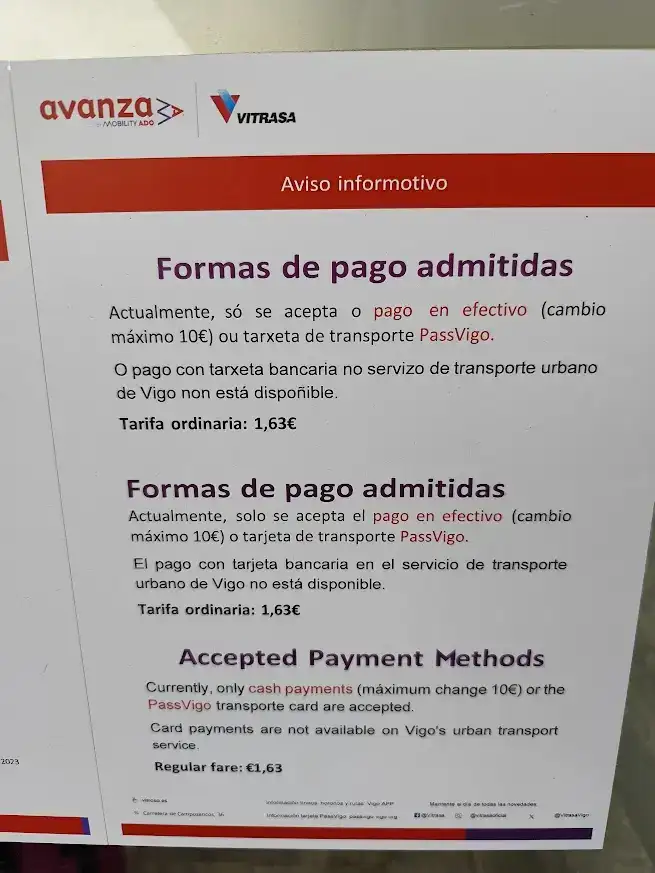
To get from the airport to the centre I took the line A bus, which runs roughly every 36 minutes (hourly on Sunday mornings)[8]. It costs €1.63, takes about 25–30 minutes, and here comes the first practical Camino tip: it does not take cards, and the driver only gives change up to €10[9]. Carrying coins saves you the last-minute scramble.
I got off at Vialia Vigo (the intermodal station), which doubles as a shopping centre: I bought water and bananas for the afternoon and carried on with the plan. I had wanted to wander around Vigo, but after the delayed flight it was better to head straight for Baiona and arrive without rushing.
The intercity bus to Baiona leaves from the same station. It is a journey of under an hour and very scenic: if you can, sit on the right-hand side to watch the ría go by.
I dropped my backpack at the guesthouse and went out for a simple dinner in the centre (I ended up with crêpes and a waffle), a short walk and then bed: on day one I only wanted to rest, so I could start walking properly the next morning.

One important note about the Pilgrim Credential in Baiona. I had also read that the church sells it; it does not. The church opens in the afternoon, but it does not issue credentials. I bought mine at the Hotel Anunciada (right in the centre) for €3. That is the quick way: you walk in, ask for it, and walk out ready to start collecting stamps on day two.
Where I stayed in Baiona
I stayed at Pensión O Escondidiño, five minutes from the centre and with an Eroski supermarket next door for last-minute shopping. Quiet at night, comfortable bed and no surprises: exactly what I need, because I sleep lightly.
Day 2, Stage 1 – From Baiona to Vigo (27 km)
- Distance
- 27 km26.8 official
- Time
- 6 h 46
- Elevation
- ↗ 128 m ↘ 104 m
- Difficulty
- Moderate long, but almost flat
- Seafront promenade
- Sand
- City tarmac
With good weather, take the coastal variant from Sabarís. Bring sun protection: there is very little shade.
Open the day's route in Google MapsI woke up in Baiona without rushing, and the first thing I did was get the credencial stamped at Pensión O Escondidiño. Before setting off, I took one last walk through the centre of Baiona. The weather was on my side (clear sky, mild temperature), so I took the coastal variant, which stays right by the sea.
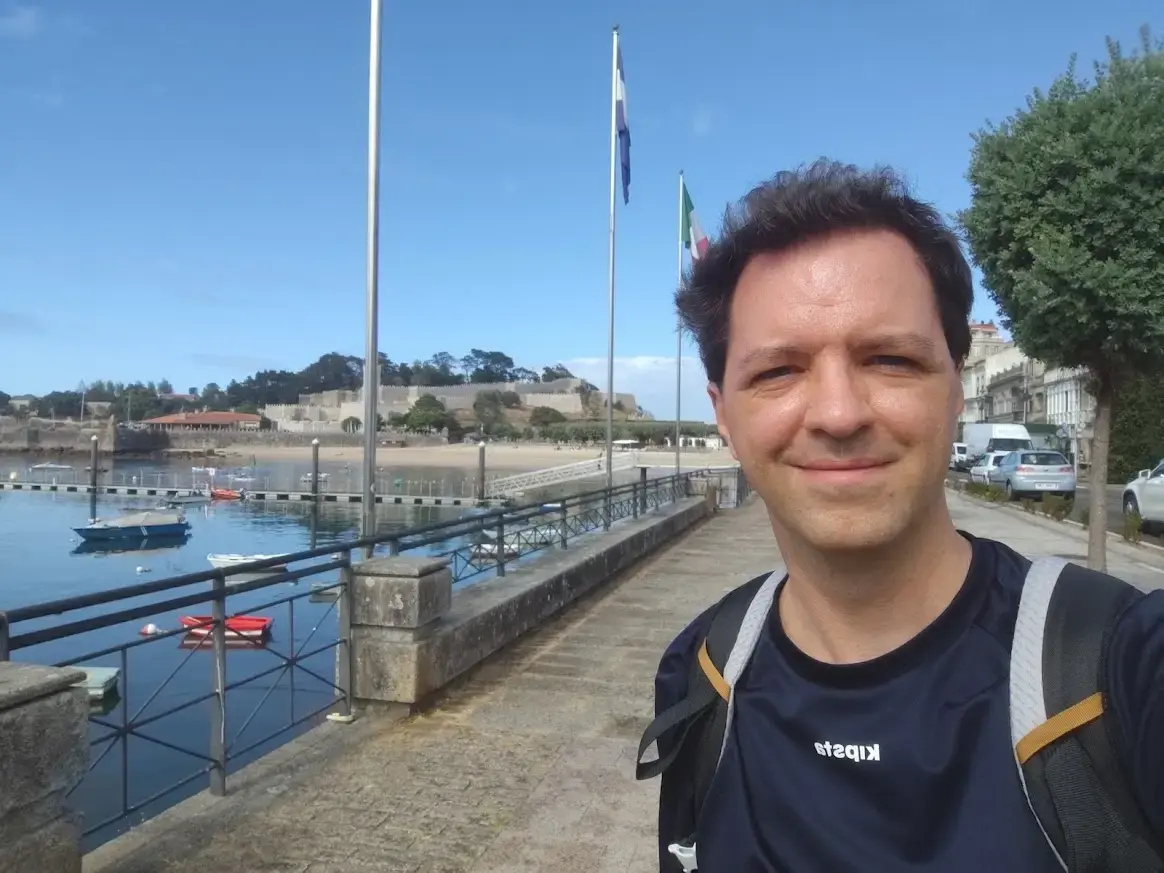
About 2 km along the promenade to the beach.
Along the promenade, to Panxón.
Along the coast, past Patos, to Samil.
It is a long but gentle stage: it is not hard, though you feel it if you leave late. That day I set off close to midday (I had a couple of things to sort out) and ended up stopping for lunch near Playa de Patos. I had a restaurant with sea views in mind, but it was full. Lesson learned: in high season, book ahead if you want a table on the front line. I improvised at a simple place next door and ate quickly to press on.
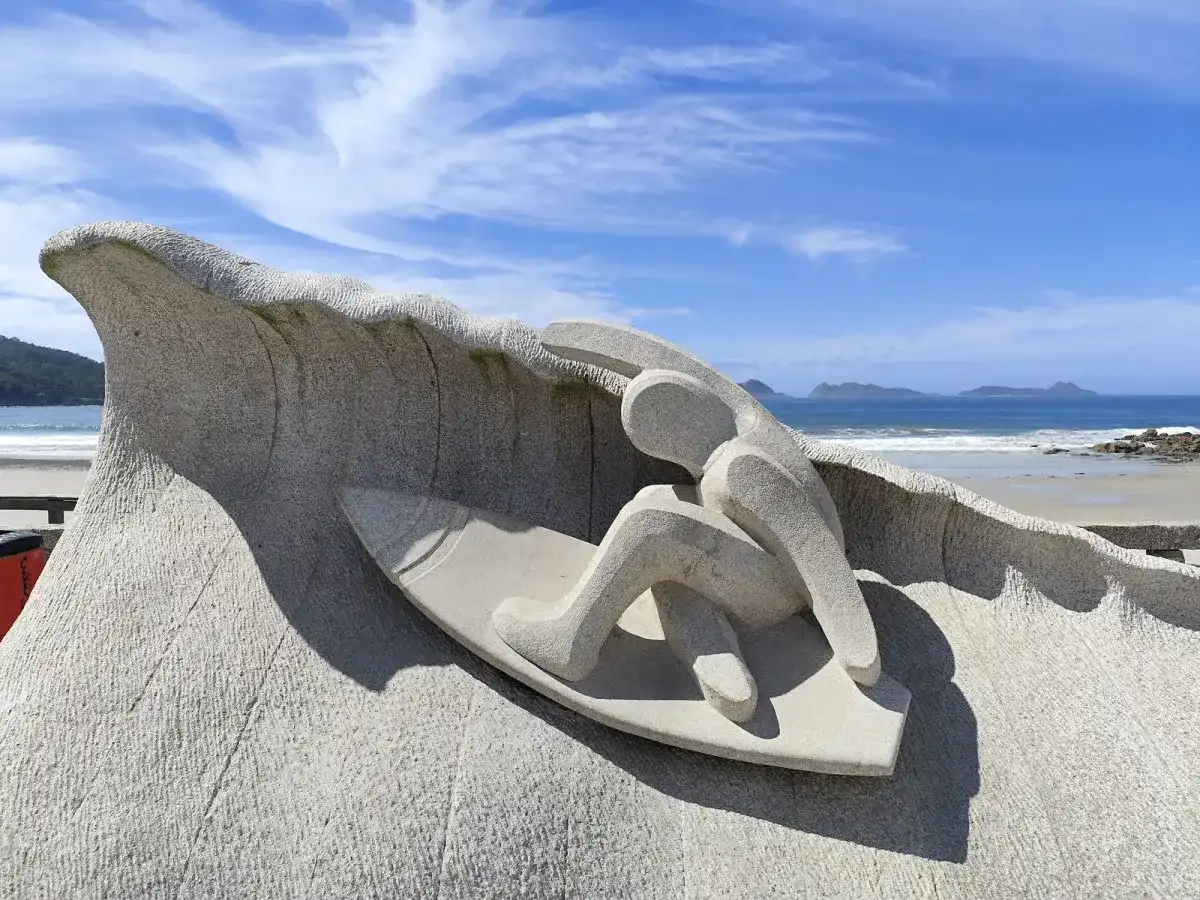
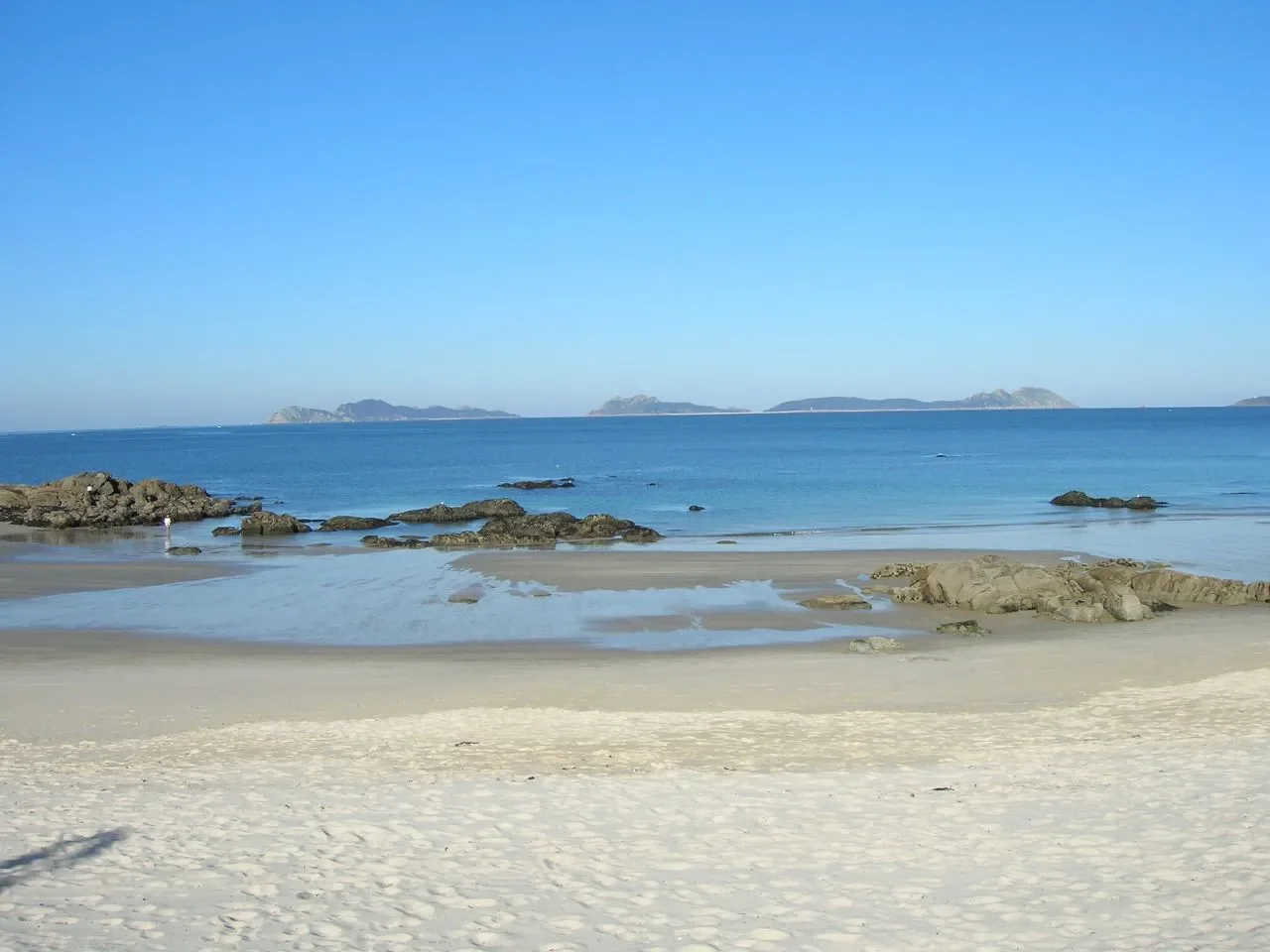
The entrance to Vigo feels endless if you arrive tired: it is a big city, long avenues and a seafront promenade that seems never to end. Patience. The upside is that you keep seeing the Cíes Islands in the distance and you gradually slide into city life.
Where I stayed in Vigo
I chose Hotel Arsus, right in the centre: 5 minutes from Calle del Príncipe and 2 minutes from Vialia Vigo (the intermodal station with the shopping centre). From there you can buy supplies in a few minutes, and the next morning you go straight down to the port route without any detours.
One logistical note that served me well for the next stage: it is better to stay past the Plaza de España roundabout, near the station (train and buses) or in the old town. That way you avoid starting the next day with the climb up to that area, which you otherwise have to cross to continue the Camino.
Day 3, Stage 2 – From Vigo to Redondela (Cesantes, 24 km)
- Distance
- 24 km15.4 official
- Time
- 5 h 41
- Elevation
- ↗ 213 m ↘ 227 m
- Difficulty
- Easy with the first climbs
- Tarmac
- Tracks
- Forest
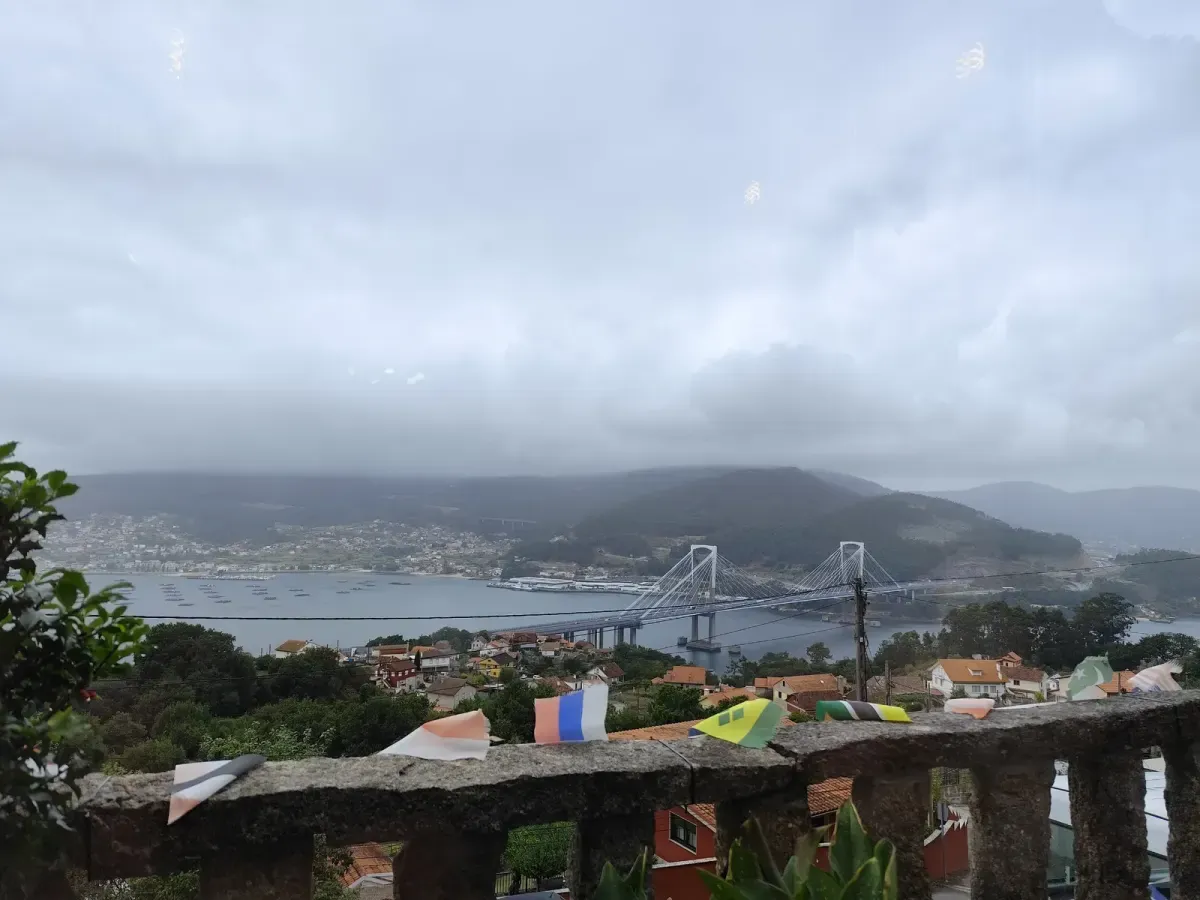
The best part: the forest stretches above the ría, with the Rande bridge below[24]. My watch recorded more because of the detour to Cesantes.
There are few places to stop between Vigo and Redondela: set off with water and something to eat.
Open the day's route in Google MapsI woke up in the centre of Vigo with a logistical advantage: sleeping on the far side of Plaza de España saved me from starting the day with an unnecessary climb. I headed down to the port to join the scenic exit the Buen Camino app recommends and, on the way, stopped at the Vigo Tourist Office (here) for the first stamp of the day. At that hour the city was calm, around 22 ºC, with that typical Galician sky that alternates clear patches and clouds.
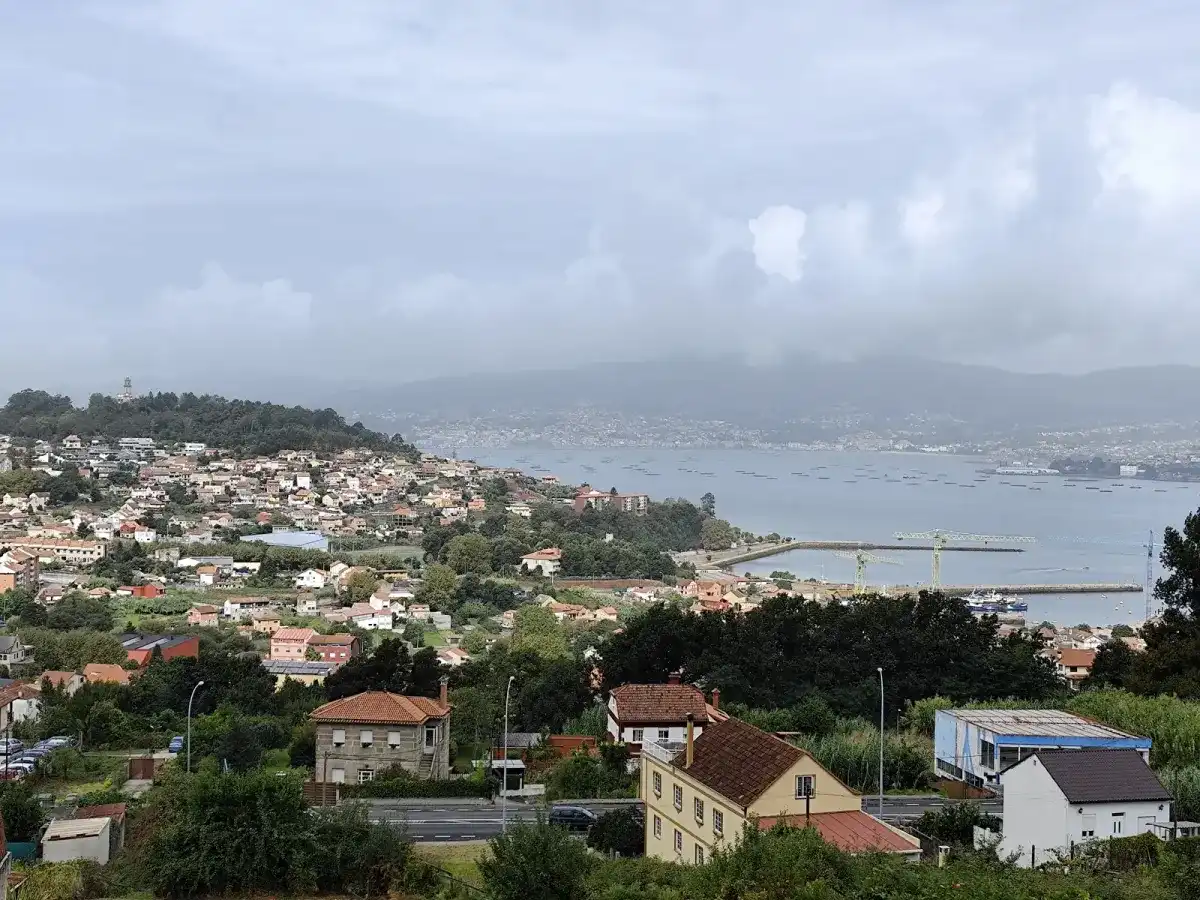
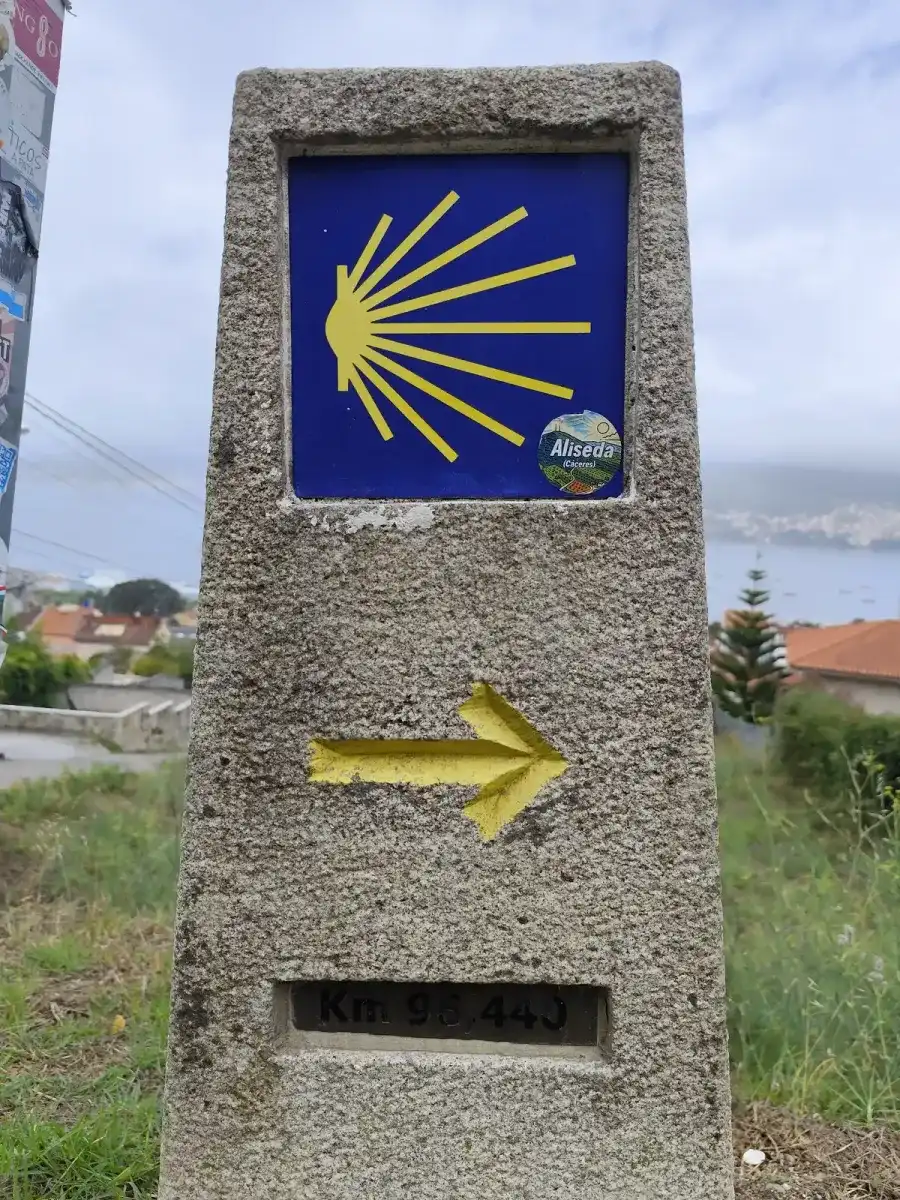
The exit through the port is pleasant and direct, but as soon as you leave Vigo behind the first serious climbs arrive. Nothing impossible, but you feel them: the route strings together urban stretches and trails and, little by little, takes you into forest. The arrows and shells of the official route appear here, so you cannot get lost. I came across more pilgrims than on previous days, though the atmosphere was still very calm, another reason I like this variant so much: it lets you walk at your own pace and, if you feel like it, in silence.
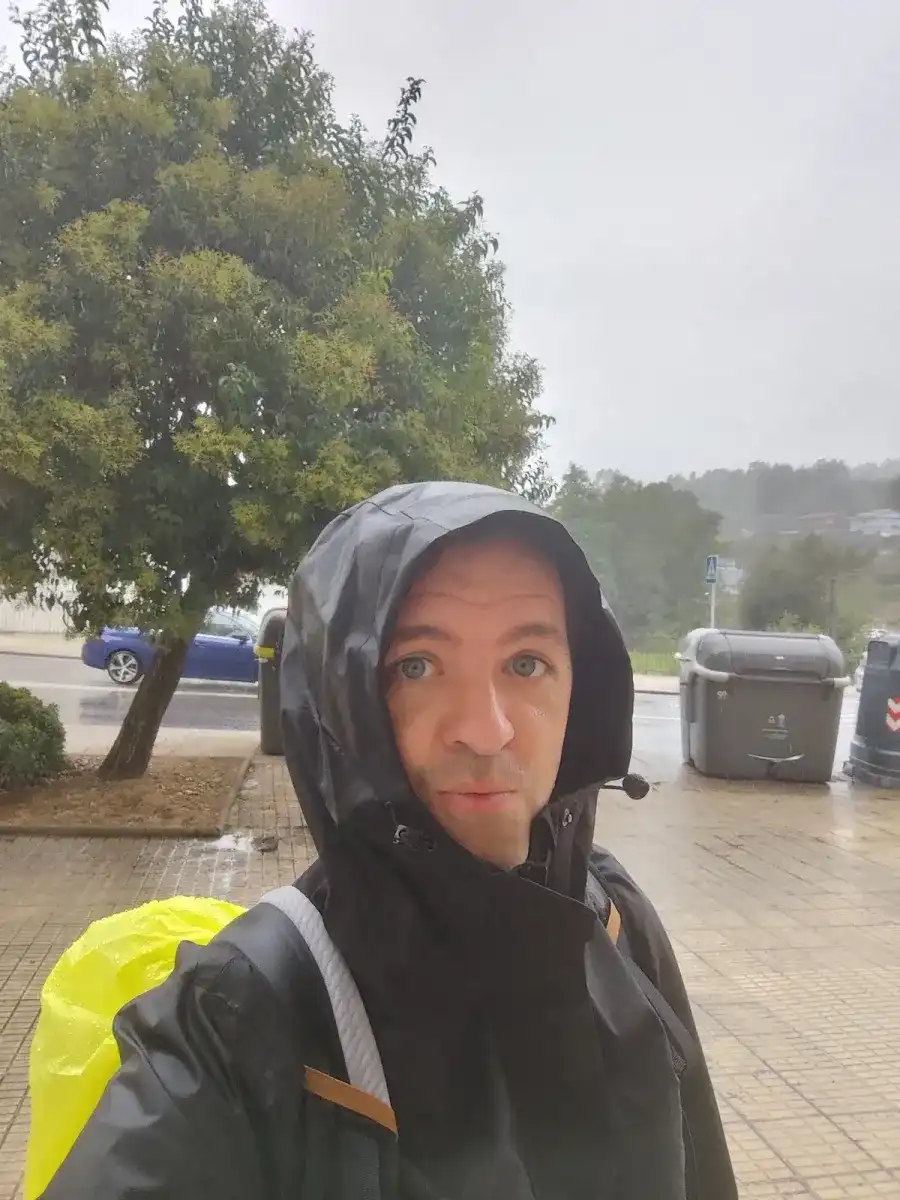
The weather did its thing: a couple of short downpours followed by clear spells. A rain jacket is enough for that, as long as it is waterproof. In Redondela I realised the jacket I was carrying was not actually waterproof and I had to buy a rain jacket there. If I started again, I would set off with a good one from day 1.
On the practical side, carry water and something to eat. Between Vigo and Redondela there are not many comfortable places to stop. Halfway through the stage, in Cabanas, there is a restaurant with views of the Rande bridge (O Eido Vello Cabanas, here) which, to be honest, struck me as expensive for what it offers and covered in too many signs telling you what you cannot do, which takes away the charm. If you still have energy, better to carry on and take a short break further ahead, in the forest.
About 20 minutes more, along the ría, to Cesantes.
Where I stayed in Redondela/Cesantes
I chose Hostal Antolín (Cesantes). It faces the beach, in a very quiet area with fantastic views of the Rande bridge. The room was large and modern, with a big shower and a terrace/balcony looking straight out over the ría, where I stretched my legs after the stage. The 20-minute detour off the Camino is worth it if you value silence and scenery. As a bonus, you can get your credencial stamped at reception in the morning before setting off again.
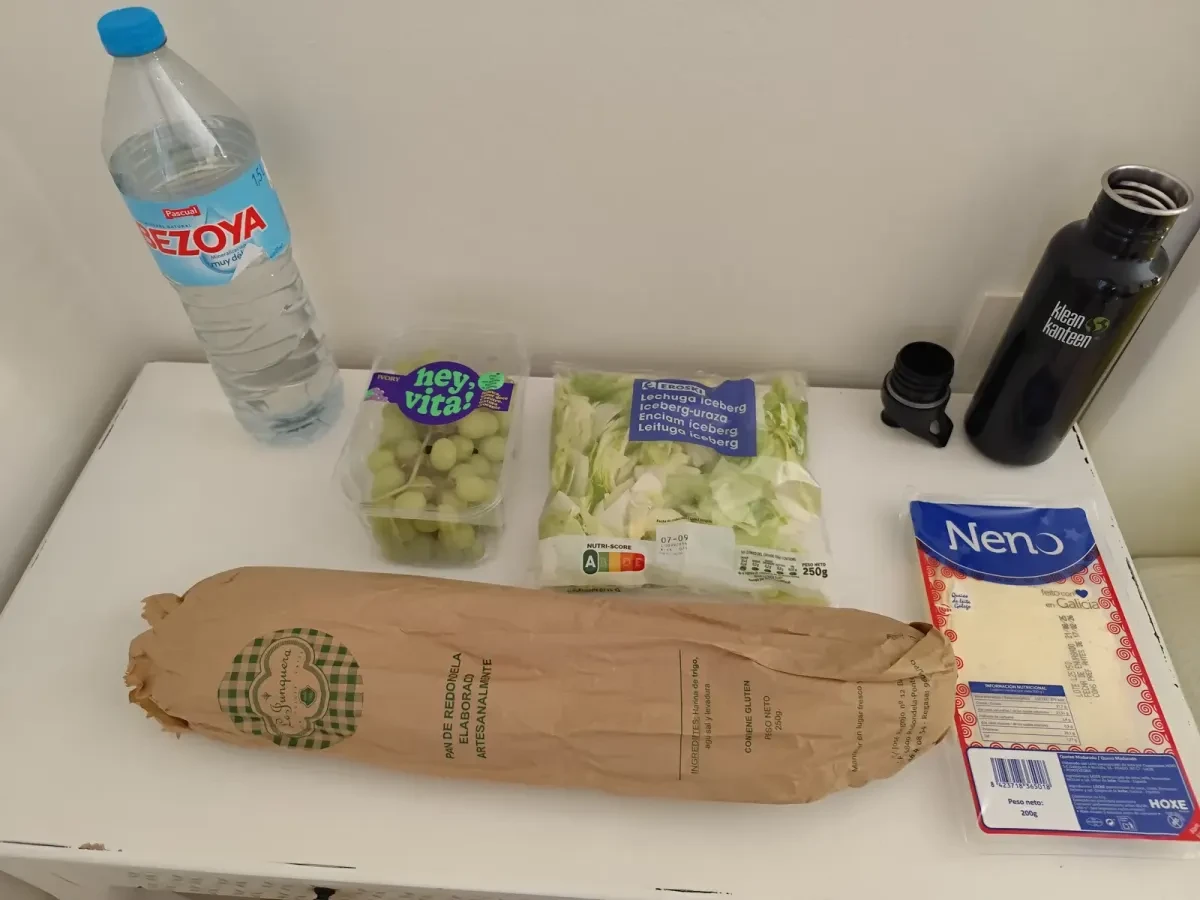
I closed the day with a practical decision: since I had read good reviews of the hotel on Booking but weak opinions about the restaurant on Google (especially about the food), I opted for a picnic dinner. I bought bread, cheese and salad and had it with grapes in my room: simple and cheap.
Day 4, Stage 3 – From Redondela to Pontevedra (22 km)
- Distance
- 22 km18.2 official
- Time
- 5 h 51
- Elevation
- ↗ 401 m ↘ 380 m
- Difficulty
- Moderate the one with the most total climbing
- Forest
- Earth and stone
- Tarmac
Eat in Arcade: after that there are few options until Pontevedra.
Open the day's route in Google MapsI started the day in Cesantes, rejoining the Camino after the detour to the hotel (about 20 minutes walking by the water). A typical Galician morning: clouds, 23 °C and the odd clear spell. There were noticeably more people than on previous days (couples, the odd solo walker) but never crowded.
Leaving Redondela mixes a bit of everything: an urban stretch to warm up and then, straight away, forest. The terrain is varied (earth, stone, the occasional short rock you climb without using your hands) with moderate elevation change; nothing extreme, but it adds up. My routine worked very well here: first stamp of the day at the hotel, before setting off.
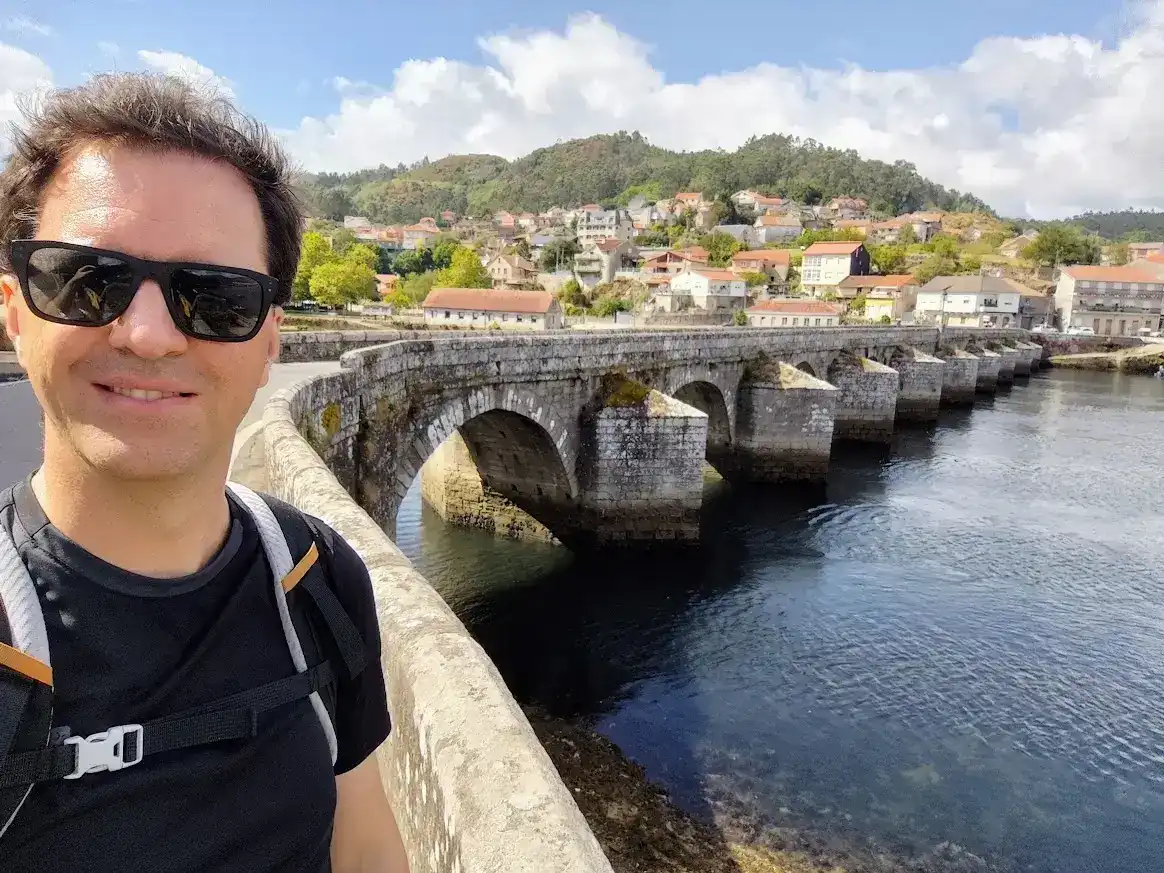
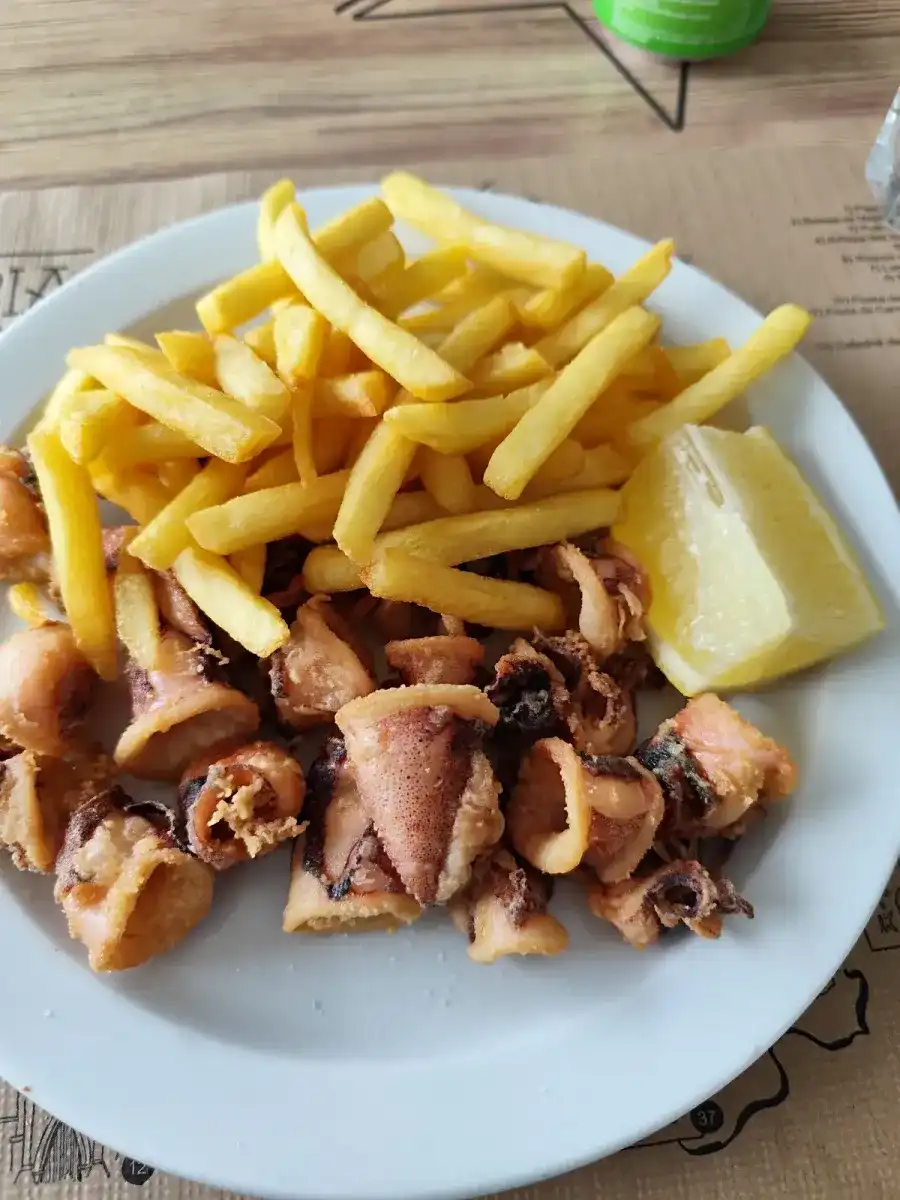
Just before reaching Pontevedra there is a fork (clearly marked in the Buen Camino app too). Out of curiosity I went straight on along the road: it is more direct, but I would not take it again: bleak villages, almost no cars, but no services and nothing to see either. If you prefer a friendlier stretch, take the longer but prettier alternative.
Arriving in Pontevedra is a relief: the last few kilometres are manageable and then, suddenly, the old town. I got there with enough time to walk around a while and get my bearings for the next day (spoiler for the next chapter: Sunday in Pontevedra means a lot of closed shops, so it is worth buying what you need on the Saturday you arrive).
Five minutes through the old town.
About 8 minutes on foot, outside the centre.
Where I stayed in Pontevedra
I stayed at Hotel Ruas, next to Plaza de la Verdura. Perfect location for getting around on foot, but I would not recommend it if resting is your priority: poor soundproofing, old furniture and you hear everything. It delivers on location and not much else; if you can, look for something central but quieter.
Day 5, Stage 4 – From Pontevedra to Caldas de Reis (24 km)
- Distance
- 24 km22.9 official
- Time
- 5 h 48
- Elevation
- ↗ 218 m ↘ 222 m
- Difficulty
- Easy
- Forest
- Earth and mud
- Vineyards
- Rural tracks
Some narrow stretches are shared with bikes: stay alert.
Open the day's route in Google MapsI left Pontevedra on a Sunday and the city was almost silent: shutters down, few people and very few shops open. That detail shaped the logistics; anything I had not bought the day before was going to be hard to find. A few minutes after leaving the centre, the Camino headed into forest. The trail was earth with some muddy patches from the overnight rain and narrow stretches shared with bikes; they appeared without warning, so I had to stay alert. It was not a hard climb, but a gentle, constant ascent that warmed up the legs. I came across very few people, and that calm helped me walk at my own pace and think.
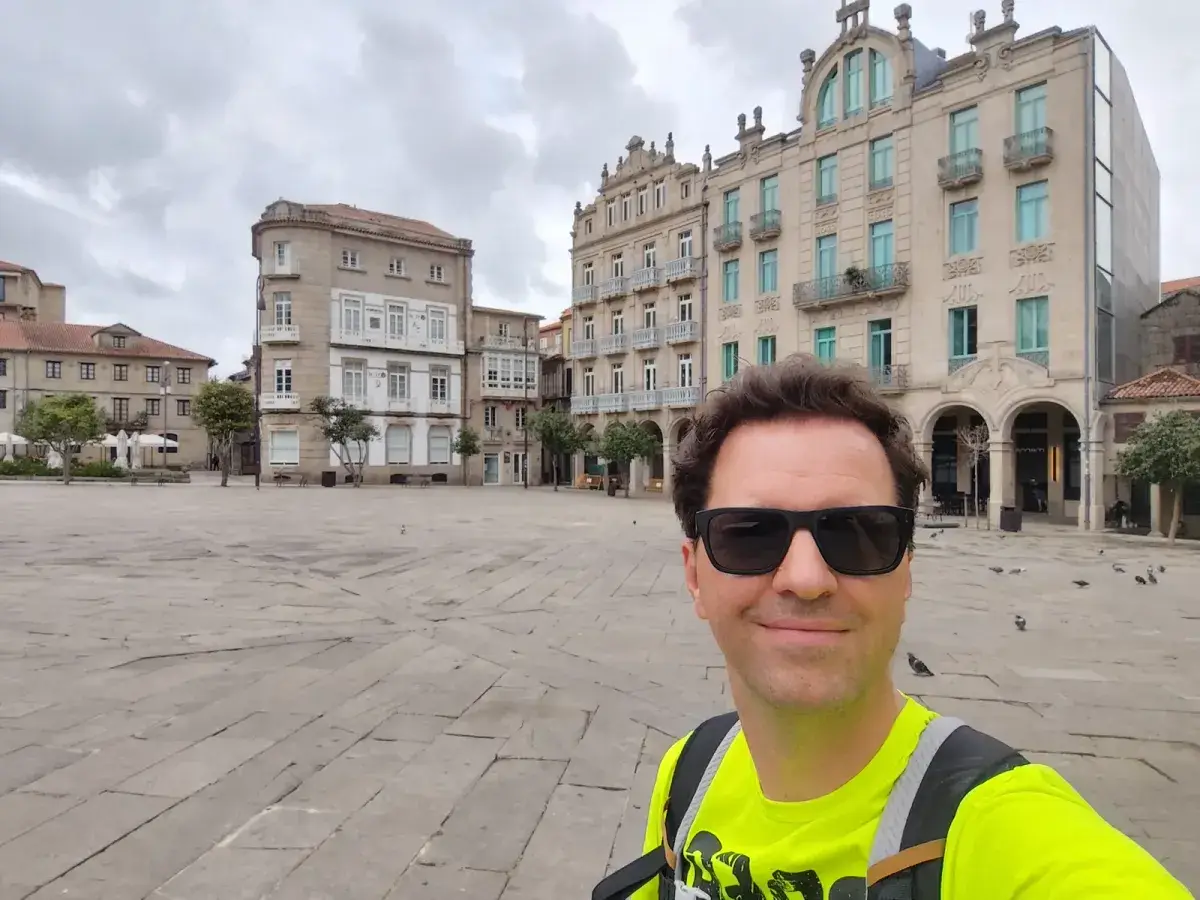
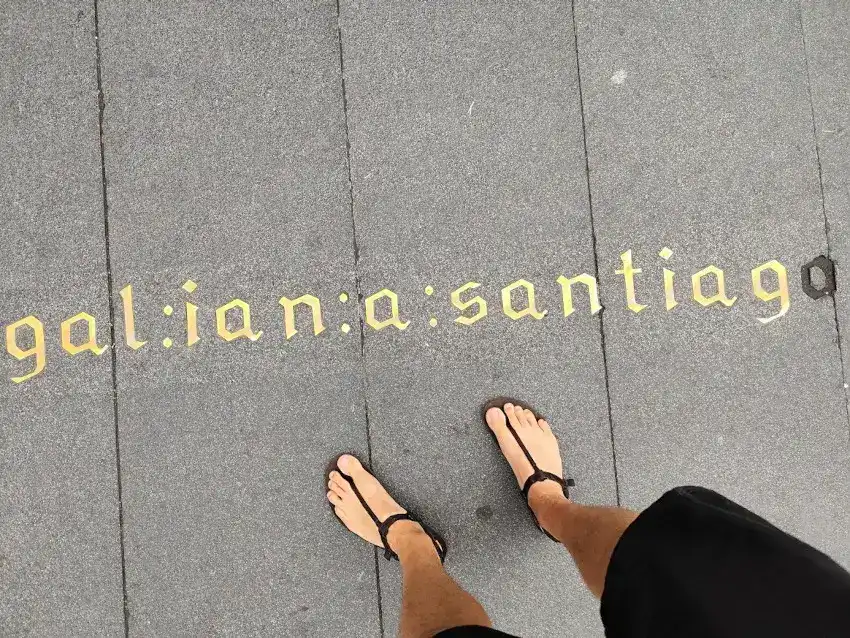
Vineyards, rural tracks and small villages. Less photogenic than the coast, but very walkable.
About 5 km to Caldas de Reis.
With half the town closed, dinner was a kebab nearby, and then rest.
Where I stayed in Caldas de Reis
I stayed at the Terra de Augas II apartment, a minute from the centre. They left the keys downstairs and I walked straight in; a long shower, a bit of tidying and silence to recover. Arriving on a Sunday to an apartment turned out to be a good call: with few places open, having your own space simplified the afternoon and left me ready for the stretch to Padrón the next day. I also had the whole apartment (two bedrooms, four beds in total) to myself.
Day 6, Stage 5 – From Caldas de Reis to Padrón (21 km)
- Distance
- 21 km19 official
- Time
- 5 h 32
- Elevation
- ↗ 187 m ↘ 209 m
- Difficulty
- Moderate it felt easy to me
- Forest
- Vineyards
- Villages
- Rural tracks
A short stage: you can leave late and soak your feet in the thermal fountain first.
Open the day's route in Google MapsI got up in no hurry: this stage is short (about 19 km on the official route)[11] and perfect for recharging before the final push to Santiago. It was a Monday, so before setting off I wandered through the street market on the main street and, almost as a ritual, stopped at the public thermal fountain to soak my feet.
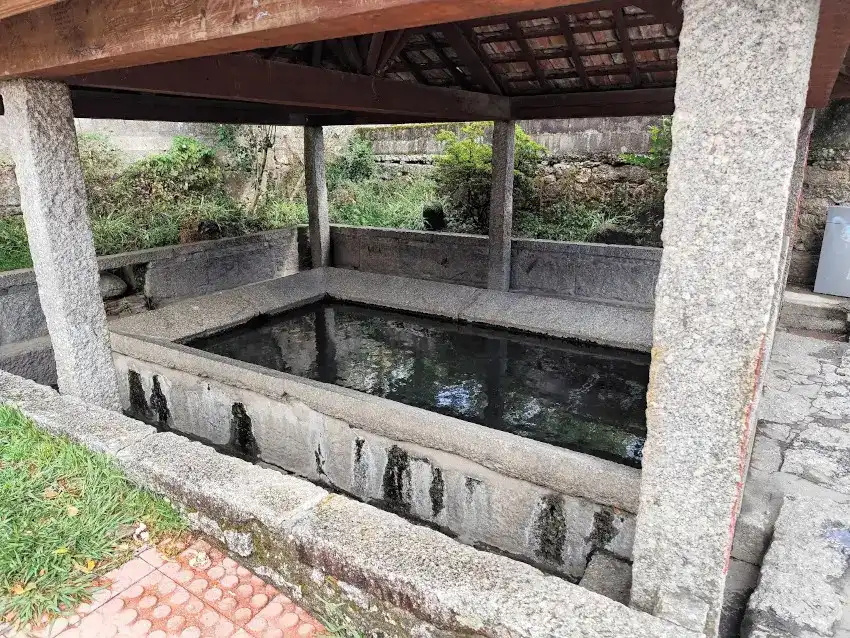
I started walking around 12:00. The first kilometres mixed quiet streets with shaded tracks and, soon enough, forest. A short downpour came down, enough to leave mud and puddles; once it cleared, the path was cool and comfortable to carry on. At that hour pilgrim traffic was low, so I moved at my own pace, unhurried.
Earth, vineyards, small villages and rural tracks, with shade when the sun comes out.
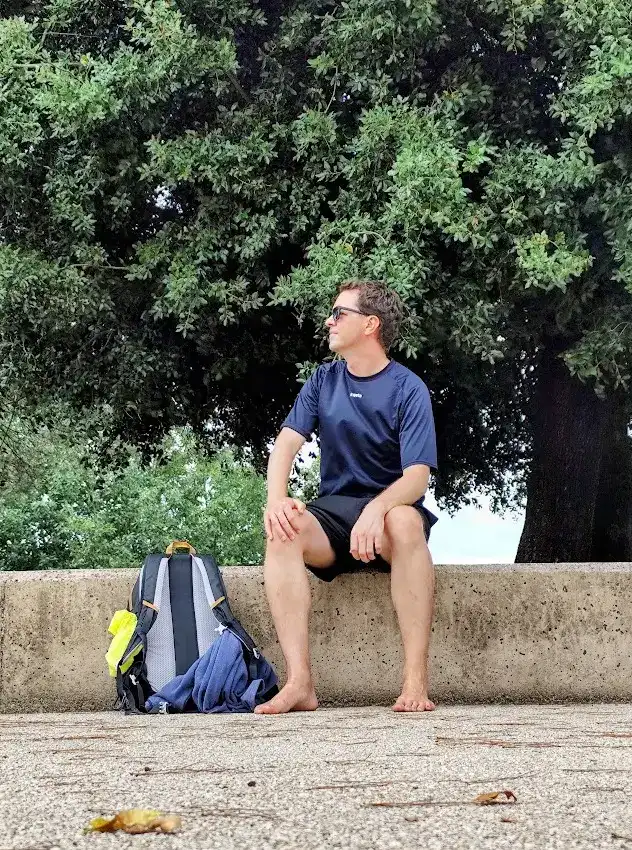
Walking calmly, I got to Padrón around 18:00. Doing the maths, I could even have left later; at a steady pace, this stage takes about 4 h 30 min.
Where I stayed in Padrón
I stayed at Apartamento Salomé, in the central area. Being so close to the old town and to the Camino route made it easy to set off early the next day without adding extra metres. And with everything at hand (the square, bars and a shop), I could have dinner and get my backpack ready calmly before the final day.
Day 7, Stage 6 – From Padrón to Santiago de Compostela (29 km)
- Distance
- 29 km25 official
- Time
- 7 h 18
- Elevation
- ↗ 405 m ↘ 157 m
- Difficulty
- Moderate the one I found hardest: the last hour is uphill
- Tarmac
- Forest and countryside
- Final climb
In the last two hours there are few places to get a hot meal: carry food in your backpack.
Open the day's route in Google MapsIt dawned raining and I decided to wait. I left Padrón around 10:30, knowing I had about 25 km[12] ahead of me and that it was going to be a long day.
The start was not especially pretty: the first kilometres hug the road, crossing neighbourhoods and plain villages while you get into your rhythm. As I went on, the route became more varied: stretches of forest and countryside that relieve the tarmac and help keep your head fresh. There were more pilgrims than on previous days; you could tell it was the final push for many of them.
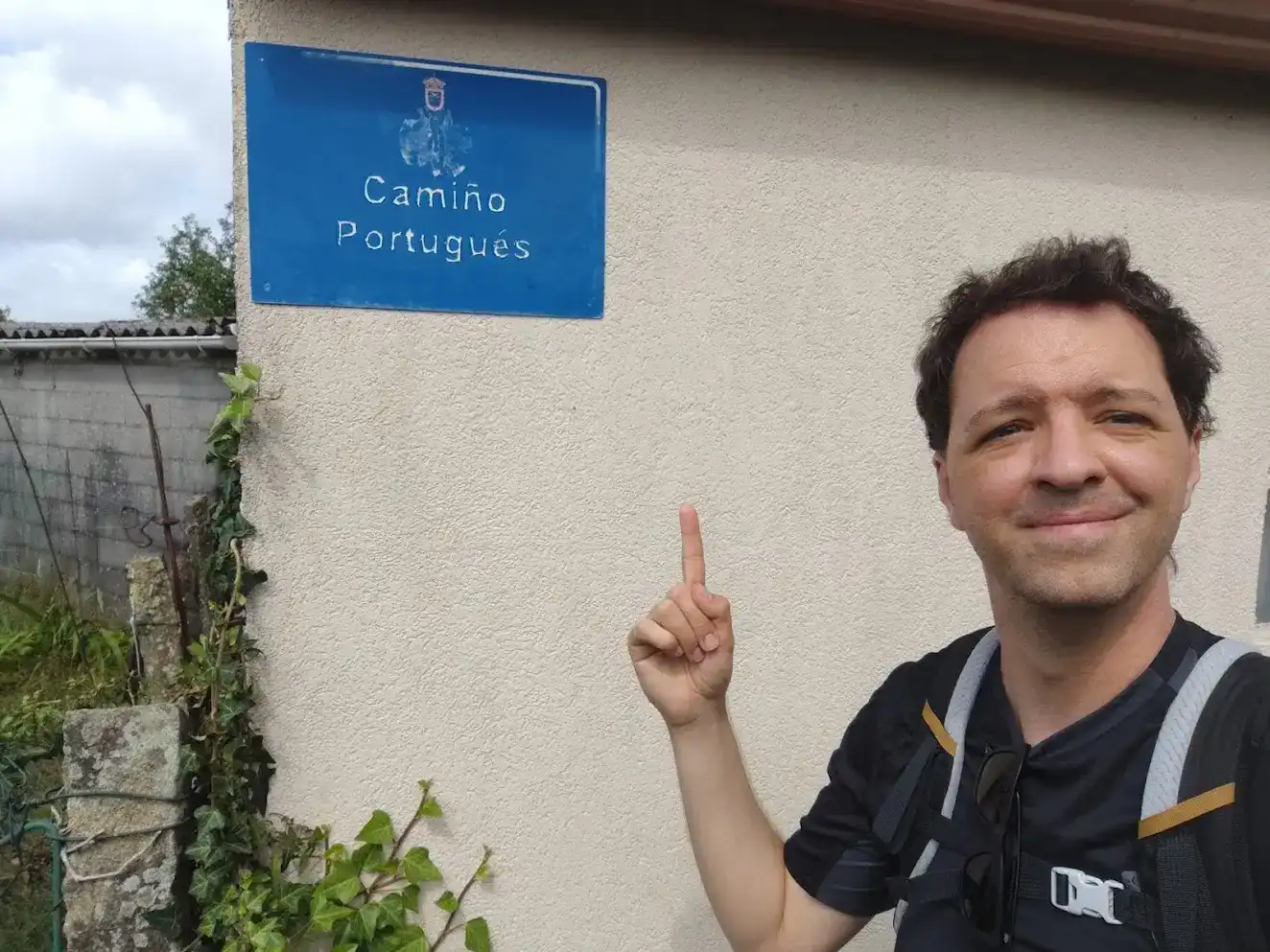
On the practical side, one thing surprised me that day: in the last two hours there are not many places to get something hot to eat. I ended up having a cold sandwich in a bar about two hours from Santiago, because there was not much else.
You feel the final stretch. Before entering Santiago there is a viaduct and the surroundings turn urban again; it is not the prettiest part, but you have to get through it. The hardest bit comes at the end: the last hour is almost all uphill. I took a short break in Ames to recharge, and I would recommend it: that pause helps you face the final ramp in better shape.
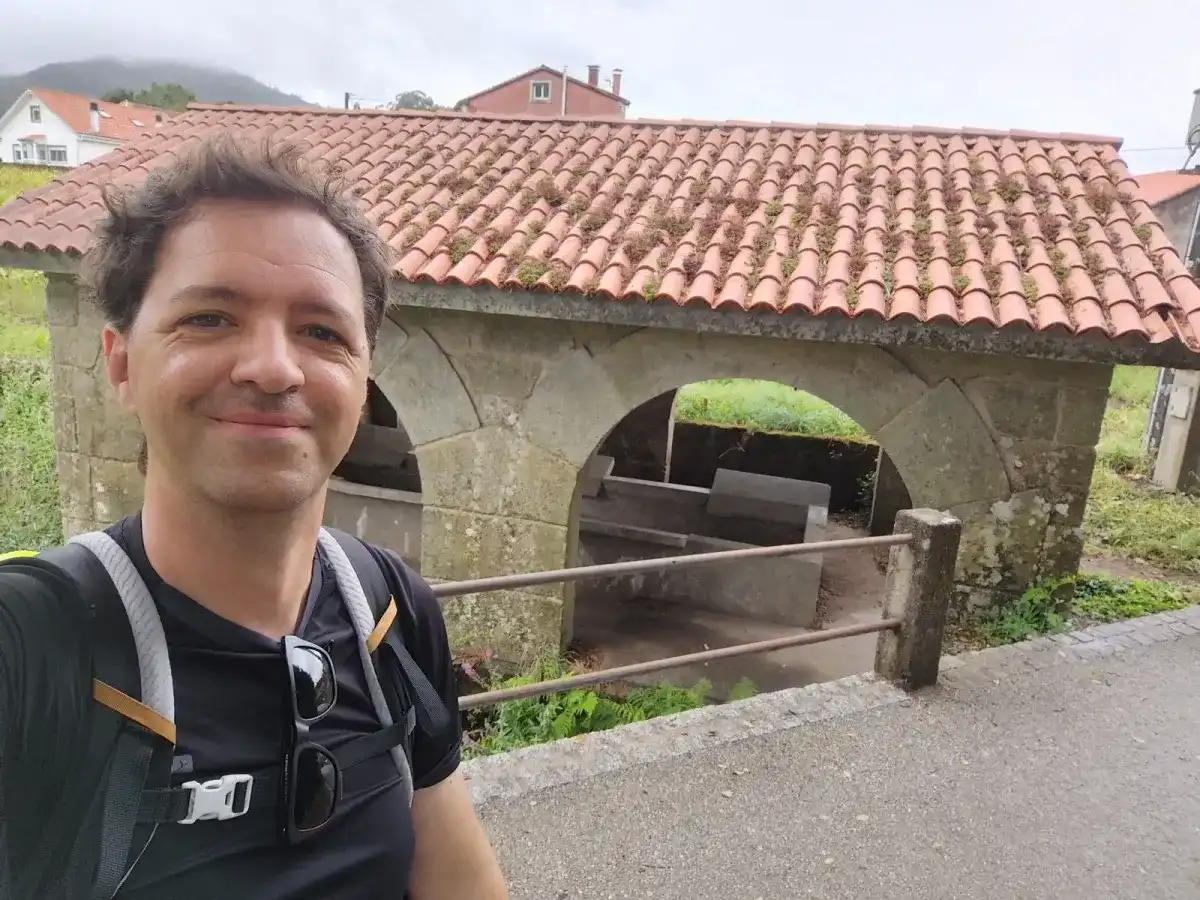
A couple of minutes, to the left of the Cathedral.
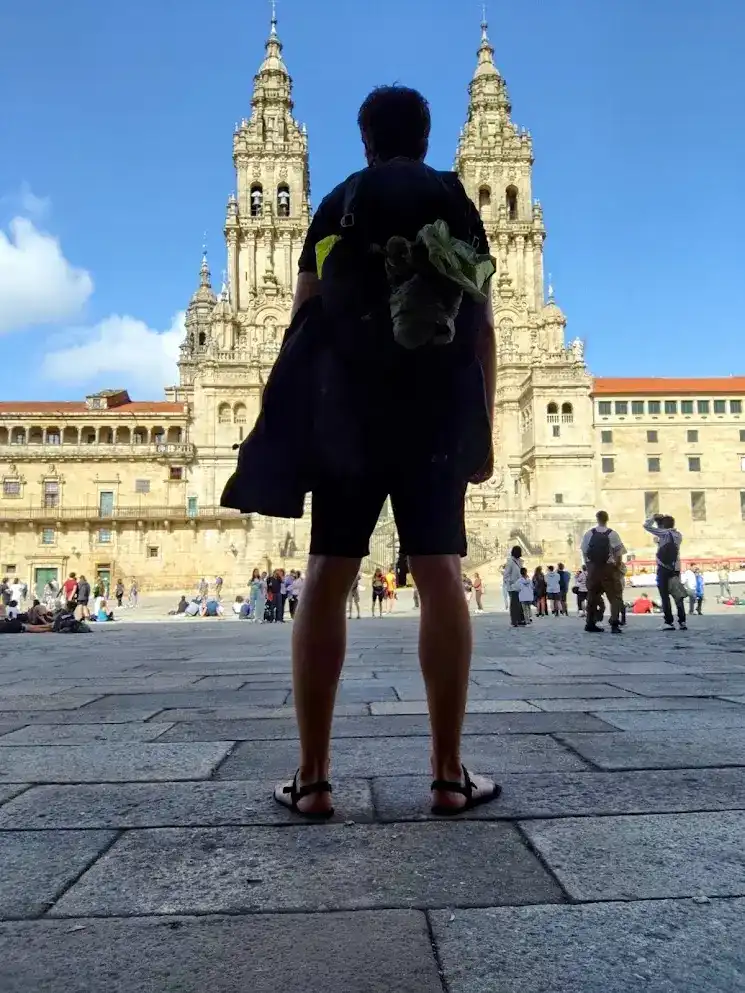
Where I stayed in Santiago
I slept two nights (the night I arrived, and the following day, which I spent discovering Santiago de Compostela) at Casa Diocesana Vía Lucis. It is a simple, very quiet place with the feel of a diocesan house: sober, well kept and aimed at pilgrims who want to rest properly after the last stage. That was what I needed after the last stage.
It worked particularly well for me logistically: you can walk to the Cathedral and the Pilgrim Office without any trouble, and at the same time you are far enough from the bustle of the old town to sleep without noise.
The Camino Portugués coastal route, ready to print
This is the route stage by stage, with what you need to know about each one: official kilometres, type of terrain, what to see, where to eat and where to get stamps. You can tick the boxes as you go (they are saved in your browser) or print it and carry it in your backpack.
Camino Portugués coastal route - from Baiona to Santiago

Full guide, with maps and prices: michieldas.com/en/camino-portugues-coastal-route/
Tick what you've already seen: it stays saved in this browser.
Day 8 – What to see in Santiago de Compostela in one day
After collecting the Compostela, I stayed one more day in Santiago. I recommend it: I wanted to see the city without a backpack, walk it calmly and have a day to wind down before going home.
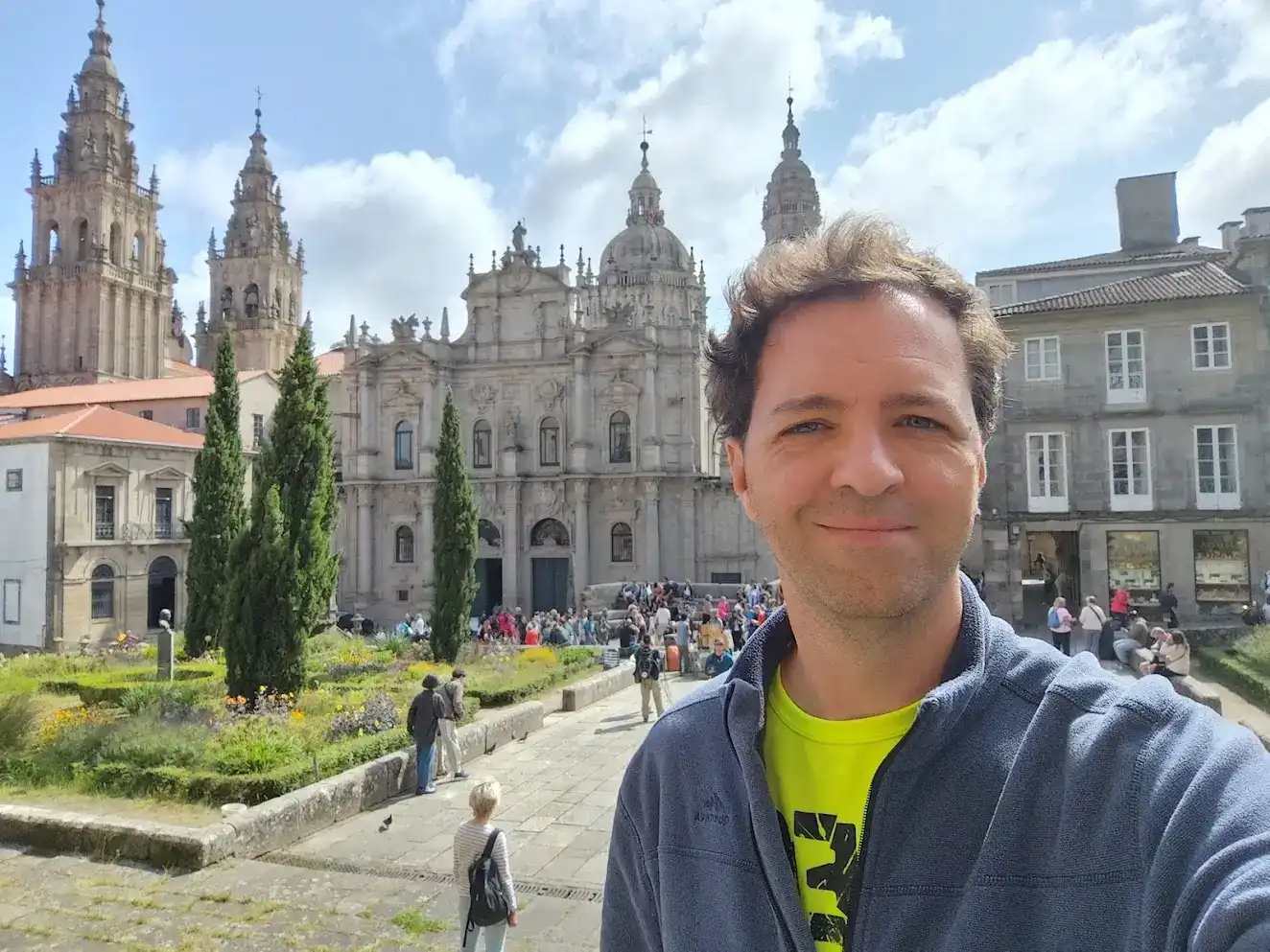
In the morning I walked the old town without rushing: Plaza del Obradoiro, the Cathedral of Santiago from different angles, arcades, small squares and those stone streets with pilgrim atmosphere at every step. The old town is full of craft shops, bookshops, souvenir shops and quiet cafés, and it is easy to wander it without a plan.
In the afternoon I did something very symbolic: I got my hair cut. Many pilgrims cut their hair or get a tattoo on arriving; I went for the first. It was my way of telling my body that the Camino was over. After that, more walking around the centre, a small purchase or two and one last loop past the Obradoiro to look at the façade in the low light.
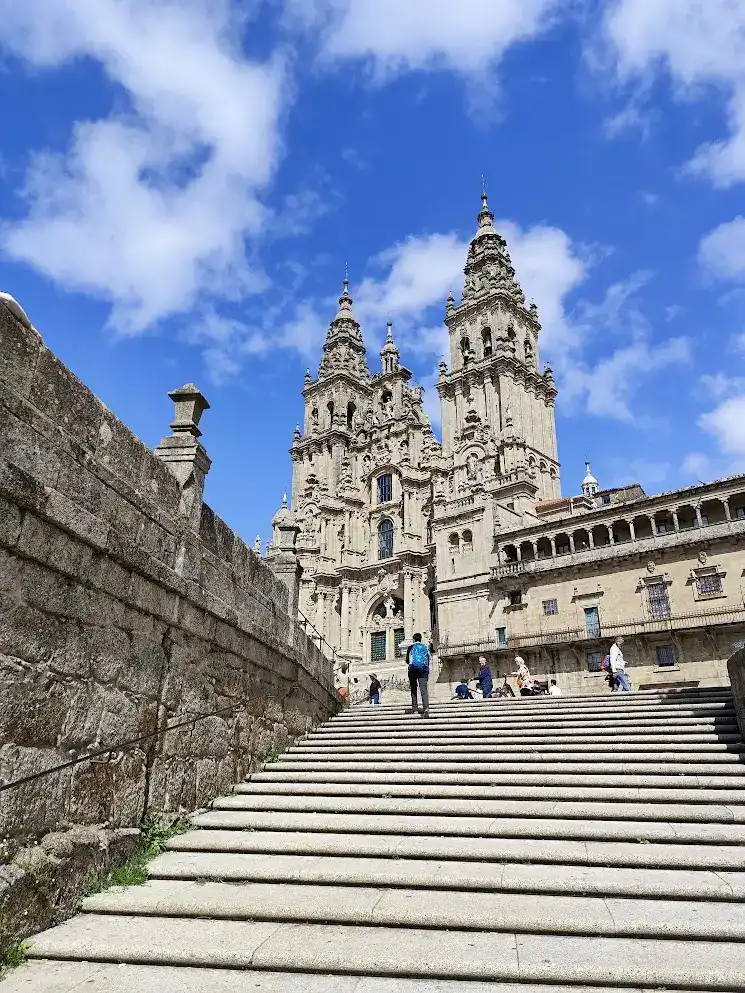
If you are considering it, my advice: set aside a full day for Santiago. In a single day you can visit the Cathedral of St James the Apostle (including his tomb) at your own pace, eat at the Mercado de Abastos, get lost in the old town and see the city by day and by night. The next day it was time to head home.
Day 9 – From Santiago de Compostela back to Barcelona
Last sunrise in Santiago. I left with time to spare towards the Hórreo Intermodal Bus Station. The airport bus is caught outside, on the street (you do not need to go into the station): it is line 6A[15], with two services, the direct one taking around 20 minutes and another making more stops and taking around 40. Both cost about €1 (also cash only) and run from 6:00 to 22:45. I took the direct one and was soon at Santiago-Rosalía de Castro airport (Lavacolla) to fly back.
If you are thinking of arriving via Vigo and returning from Santiago, my experience is that it pays to buy the flights separately. When I compared prices, the multi-destination combination came out more expensive than two simple tickets (Barcelona → Vigo and Santiago → Barcelona). Buying them separately I got better times and a better price.
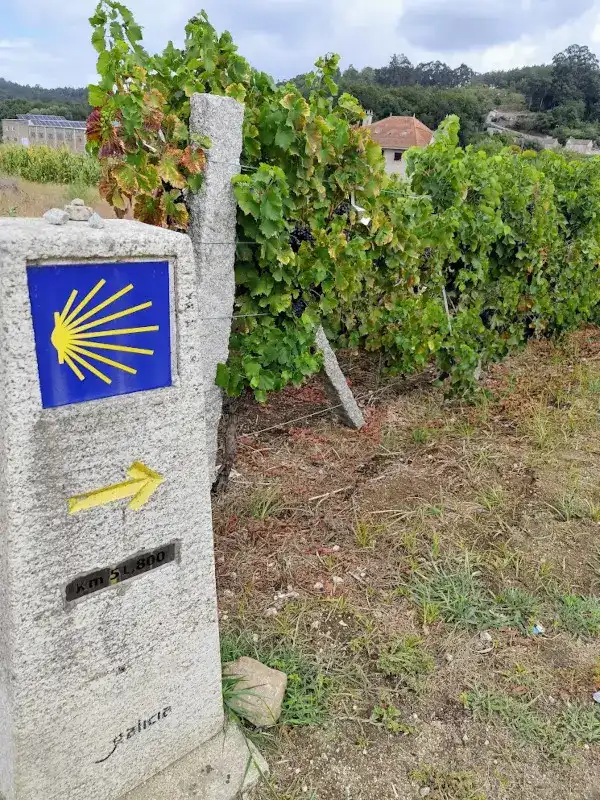
How to walk the Camino Portugués from Porto or from Tui
I started in Baiona, but most pilgrims set off from Porto or from Tui. I have not walked those sections, so there is no diary here: I summarise where each option goes with the official distances, and I mark where it joins my route, because from that point on everything in this guide (accommodation, stamps, where to eat) applies to you too.
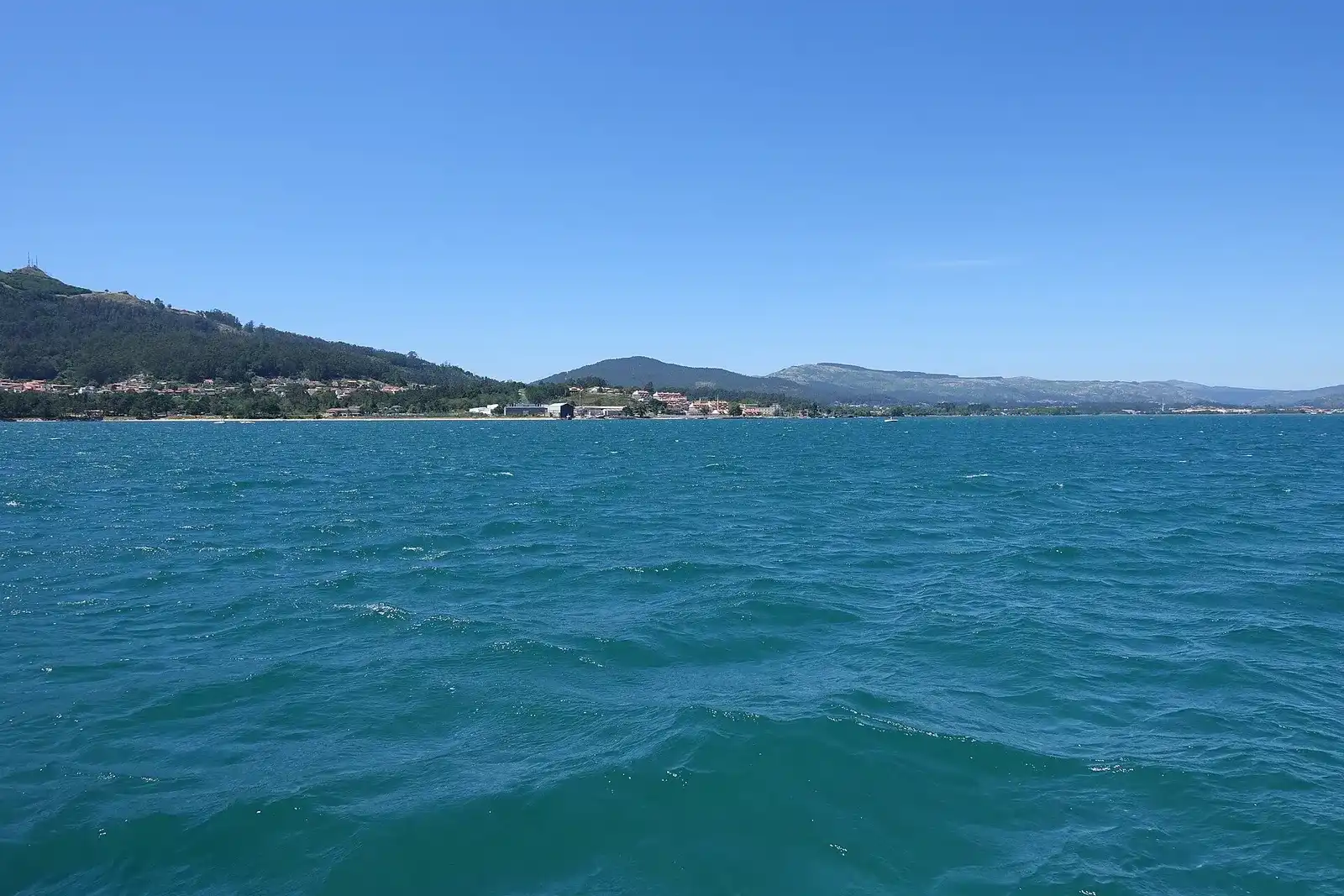
From Porto along the coast: about 270 km in 13 stages
This is the full Portuguese Coastal Way: you leave Porto and head north right along the Atlantic to Galicia. From Porto to Redondela it is 187 km[18], and from Redondela you have the same four stages I walked, about 85 km on the official route[20][21][11][12]. In total, about 270 km: almost two weeks of walking.
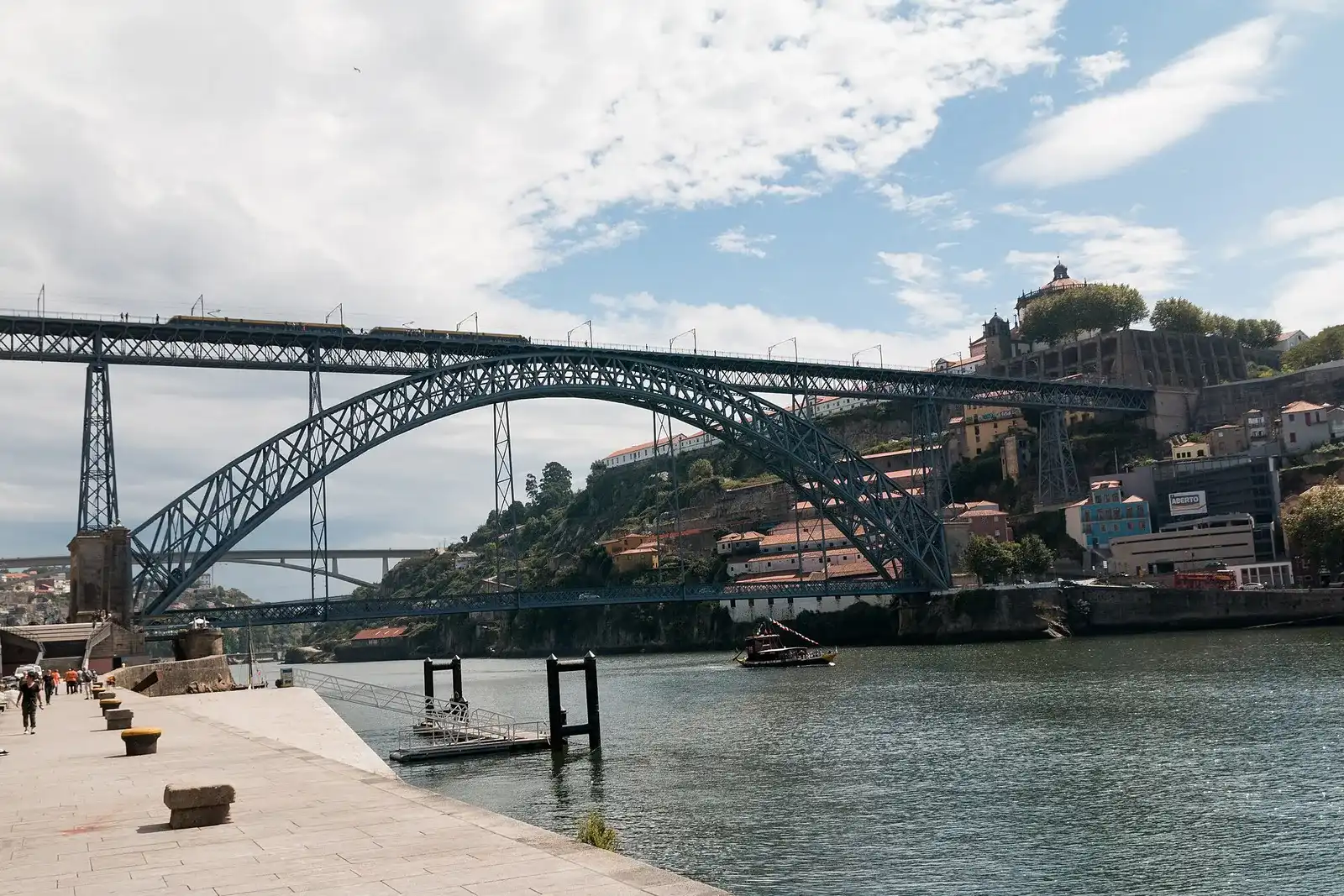
These are the usual stages until you join my route[18]:
| Stage | Route | Distance |
|---|---|---|
| 1 | Porto → Labruge | 24.5 km |
| 2 | Labruge → Póvoa de Varzim | 14 km |
| 3 | Póvoa de Varzim → Marinhas (Esposende) | 24.5 km |
| 4 | Marinhas → Viana do Castelo | 20.8 km |
| 5 | Viana do Castelo → Caminha | 26.8 km |
| 6 | Caminha → A Guarda → Porto Mougás | 23.5 km |
| 7 | Porto Mougás → A Ramallosa (Baiona) | 16 km |
| 8 | A Ramallosa → Vigo | 21.5 km |
| 9 | Vigo → Redondela | 15.4 km |
What you need to know about this section:
- The Portuguese part is the longest: five stages to Caminha, the last town before the border.
- In Caminha you cross the Miño to A Guarda, already in Galicia[1]. From there the route follows the coast to Oia and Baiona.
- Stage 7 ends in A Ramallosa, next to Baiona: from there it is exactly my first stage to Vigo, the stretch of beaches I liked most.
- If you only have a week, you do not need to start in Porto: setting off from Baiona or Vigo is enough for the 100 km the Compostela requires.
From Tui: the Central Portuguese Way in 6 stages
Tui is one of the most popular starting points on the Camino Portugués: it sits on the Galician bank of the Miño, across from Valença, and from there it is about 119 km to Santiago[19], just what you need for the Compostela. Some people start in Valença and walk across the international bridge, so they enter Spain on foot.
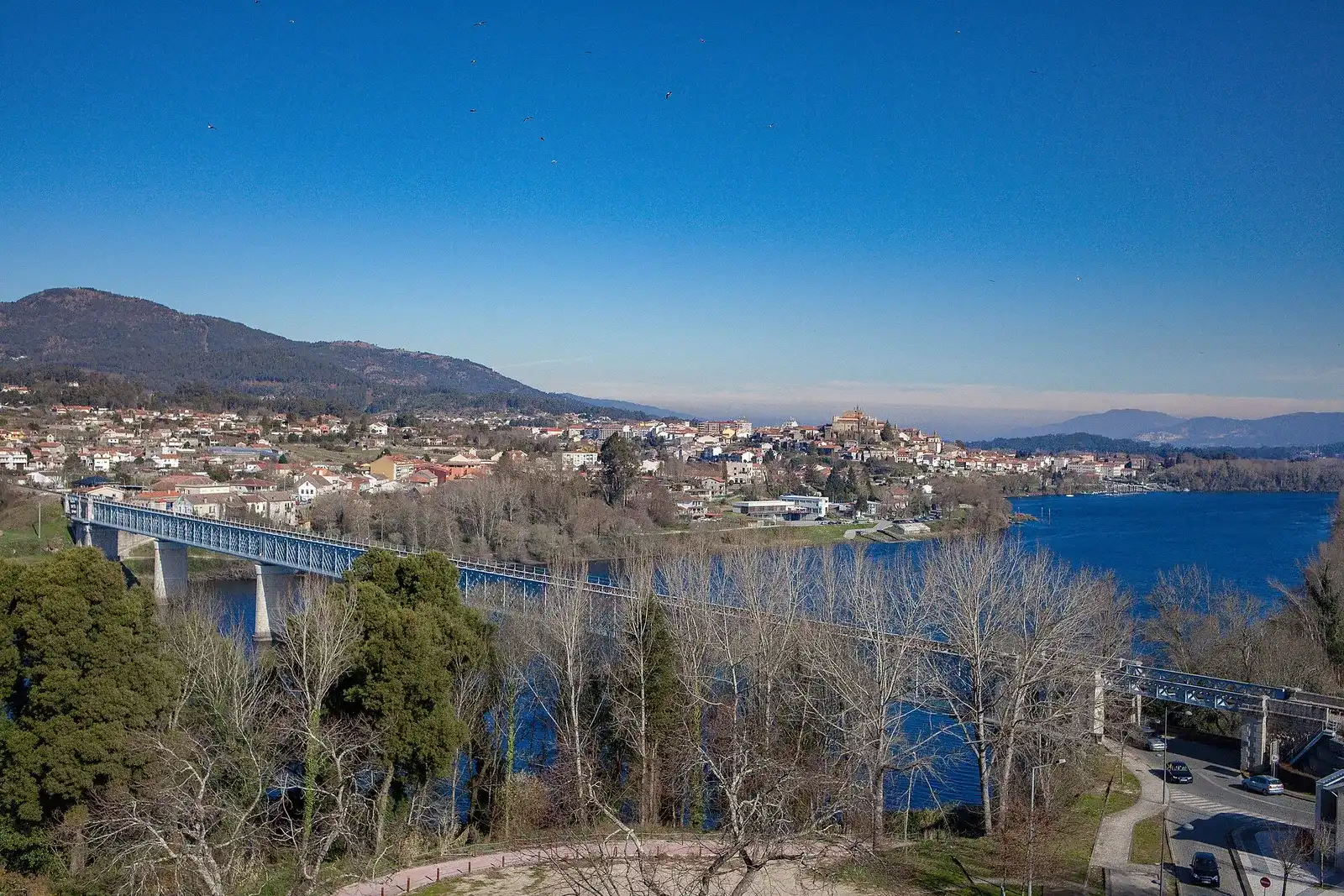
One thing to watch: from Tui you do not follow the coast, but go inland on the Central Portuguese Way. It has 6 official stages[19]:
- Tui → O Porriño
- O Porriño → Redondela
- Redondela → Pontevedra (18.2 km[20]): this is where the two routes meet, and it is my third stage
- Pontevedra → Caldas de Reis (22.9 km[21])
- Caldas de Reis → Padrón
- Padrón → Santiago de Compostela
So from Redondela onwards you will walk through the same places I did: the Sampayo bridge in Arcade, the thermal fountain in Caldas, the vineyards before Padrón and the final climb into Santiago. The difference is the first two days, which have no sea. If you are torn between the two routes, the question is simple: if you want coast, beaches and fewer people, start in Baiona or Vigo; if you want the more classic Camino and you are coming from Portugal, Tui is the natural choice.
The essentials of the Portuguese Coastal Way, in short
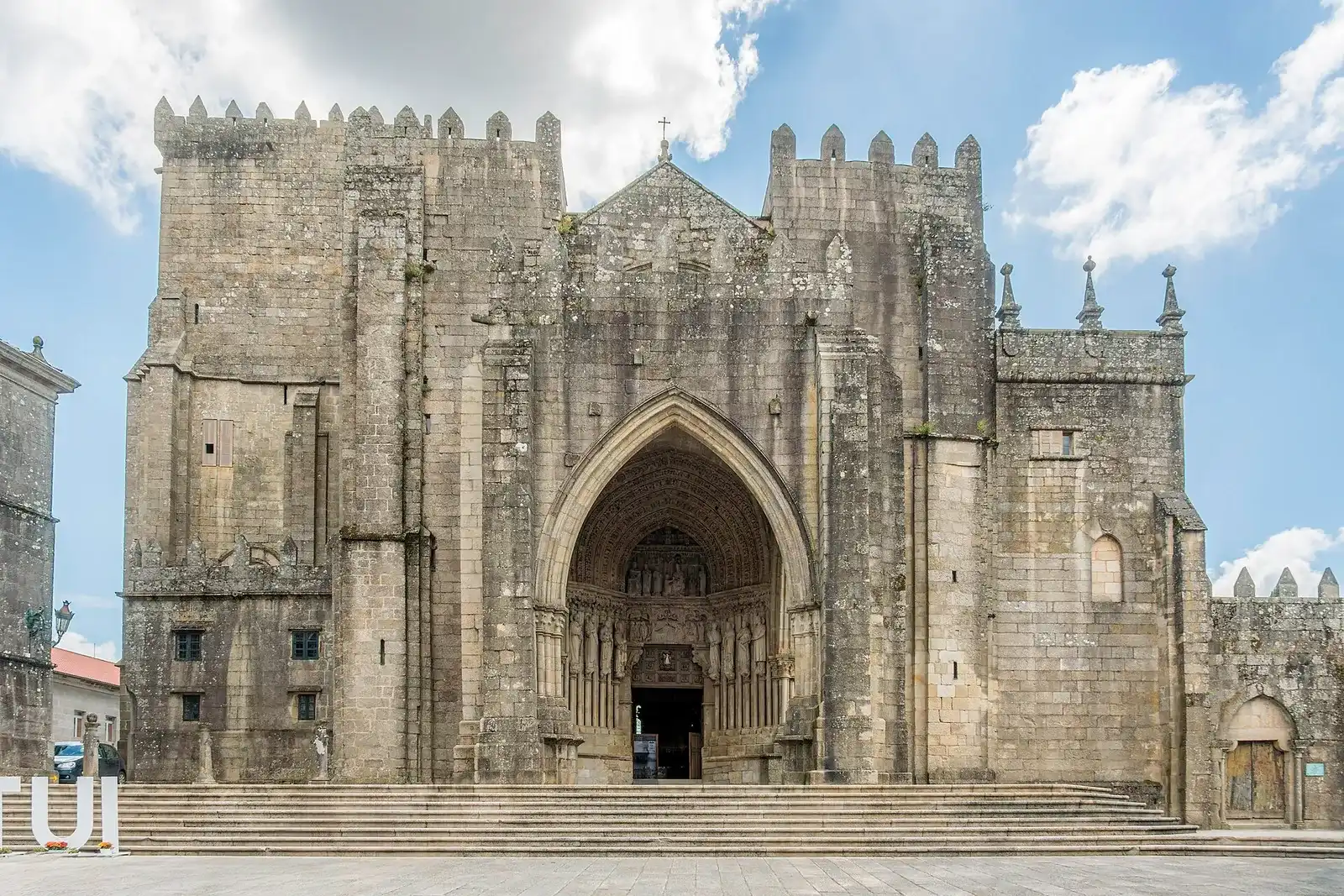
Before wrapping up, one last look at the essentials: it was ~128 km from Baiona to Santiago, split into 6 stages. I walked the Camino light, with simple logistics (bookings with free cancellation, credencial to hand, two stamps a day) and without obsessing over times. On several stretches (especially in the forests, or already close to Santiago) hot food is scarce, so it worked for me to always carry water and something to eat in my backpack. What I remember most: the beaches before Vigo, the thermal fountain in Caldas and walking into the Plaza del Obradoiro.
And if your next trip is a city one, here is my 7-day New York itinerary, one area per day.
Buen Camino!
Frequently asked questions about the Camino Portugués coastal route
Can you walk the Camino Portugués Coastal Route in 5 days?
Yes, but by trimming the start rather than compressing the end. The cleanest way is to begin in Vigo instead of Baiona: that is 120 km by my own tracking (about 101 on the official route)[1][3], split into 5 stages of between 21 and 29 km, and you clear the 100 km the Compostela requires, if only just[4]. The alternative of merging two short stages leaves you a day of more than 40 km, and my longest stage was 29 and was already hard at the end. What you lose by starting in Vigo is the beach stretch between Baiona and Vigo, which for me was the prettiest of the six.
How many stages does the Portuguese Coastal Way have?
It depends on where you start. From Baiona, 6 stages and about 128 km[1], which is what I did. From Vigo, 5 stages and about 101 km[3], just over the Compostela minimum. From Porto, around 13 stages and about 270 km[18]. And if you start in Tui you are not on the coast but on the Central Portuguese Way: 6 stages and about 119 km[19], which joins the coastal route in Redondela. It is all in the Porto and Tui section.
Which stage is the prettiest, and which is the hardest?
For me the prettiest was the first one, from Baiona to Vigo: almost all of it by the sea, with stretches that run along the sand. The hardest was the last one, from Padrón to Santiago: 29 km on my watch, the start right next to the road and the last hour almost all uphill.
Which is easier, the Camino Portugués or the Camino Francés?
I have not walked the Francés, so I cannot compare the effort first-hand. What I can tell you is that the Portuguese Coastal Way is fairly flat and not technically difficult, and much quieter: I walked a good part of it alone, while the Francés is the route with the most pilgrims.
When is the best time to walk the Portuguese Coastal Way?
I went at the end of August 2025 and it was perfect: around 23 ºC, sun with short showers and few people on the coast. One thing worth knowing: 2027 is a Jacobean Holy Year, because 25 July falls on a Sunday, and far more pilgrims are expected than in a normal year[22]. If you go that year, book your accommodation further ahead.
What time should you set off each day?
Almost everyone leaves at 6 or 7 in the morning, especially people sleeping in albergues who want to make sure they get a bed. I set off around 10 or 10:30, after a good night and breakfast, and reached my accommodation around 6 or 7 in the evening. Since I booked ahead, I was in no hurry to arrive early. Here is my full daily routine.
How much does the Portuguese Coastal Way cost?
In 2025, my 9 days, Barcelona to Barcelona, cost €1,237.94: €334.98 in flights, €504.80 in accommodation (8 nights in a single room, about €63 a night), €286.85 in food (about €32 a day) and the rest on gear, transport and souvenirs. Without flights and souvenirs, the Camino itself came to about €873. Sleeping in albergues and booking flights early makes it a lot cheaper. The breakdown is in my real budget.
Are there albergues on the Camino Portugués Coastal Route?
Yes, there are albergues along the whole route, but I did not use a single one: I am a light sleeper and I need to rest properly, so I went for pensiones, guesthouses and apartments booked in advance on Booking, with free cancellation. If you are going to use albergues, count on two things: many do not take reservations, and the ones in Redondela fill up early. That is what made me carry on 20 minutes further to Cesantes, and I ended up sleeping facing the ría with views of the Rande bridge.
Do I need to bring a power bank?
Not essential, but if you plan to use your phone heavily (photos, maps, apps) it can be worth it. I set off every morning at 100% and used the lunch break for a quick charge. The trick that worked for me: airplane mode while walking, and going online only now and then. In my experience I had 5G coverage on practically the whole route, even in the forest sections, and the waymarking is very clear.
Are there toilets along the way?
Surprisingly, there are almost no public toilets next to the trail. The normal thing is to use the bars and cafés in the villages. If you really cannot wait, move discreetly away from the path, respect private property and the surroundings, and leave everything clean.
How many stamps do I need and where do I get them?
For the Compostela you need at least 100 km on foot (or 200 km by bike) and, over the last 100 km, two stamps per day. My system: one in the morning at the accommodation and one at midday (a bar, a church or a tourist office). In Baiona I bought the credencial at Hotel Anunciada for €3.
Can I walk it in minimalist footwear?
Yes and no. I walked 95% of it in minimalist sandals (5 mm sole) and barefoot, because I am transitioning to minimalist footwear: nothing hurt, I got no blisters and my feet stayed cooler. I also carried minimalist shoes (4 mm sole) and flip-flops for the shower. That said, if your feet are not used to it, comfortable trainers are the safer choice (avoid the typical heavy mountain trekking boots).
Do I need apps or GPS?
The waymarking (yellow arrows and shells) is very good. Even so, the Buen Camino app helped me pick variants (for example the scenic exit through the port in Vigo), find stamps and check elevation profiles.
Do I need cash? How much?
Yes. I would carry €50–80 in small notes and coins. You will need it for buses (in Vigo, for instance, they do not take cards and the driver only gives change up to €10), small bars and minimum payments. Use your card for everything else.
Are there drinking fountains along the stages?
Yes in villages and parks, but not on every stretch. Always carry 1–1.5 L of water.
What should I wear if it rains?
In Galicia the rain comes and goes. Bring a proper rain jacket and a waterproof cover for your backpack. Light, quick-drying layers and a dry bag for your phone.
What time is the pilgrim mass and where do I get the Compostela?
In Santiago there is a pilgrim mass at 9:30, 12:00 and 19:30, but since 16 October 2026, and until further notice, it is held in the church of San Agustín instead of the Cathedral, because of the works in the main chapel[16]. For the Compostela, the Pilgrim Office is to the left of the Cathedral: with your stamped credencial you scan the QR code and they hand you the Compostela.
Is it safe to walk the Camino de Santiago alone?
Yes. I walked a good part of it alone and never once felt unsafe: people in the villages are very friendly and there are always other pilgrims ahead of you or behind you. The coastal route is also much quieter than the Camino Francés. Take the usual care when crossing roads, and wear a reflective vest or a light if you set off very early (I left around 10, with plenty of daylight).
Can you do the Camino Portugués Coastal Route by bike?
Yes, and you will meet cyclists along the way: some narrow stretches are shared with bikes. But if you want the Compostela, by bike you need at least 200 km in a row on the same route, ending at the Cathedral[4], and from Baiona to Santiago it is about 128 km[1]. To earn it by bike you would have to start much further south, in Portugal.
What other pilgrimage routes are there besides the Portuguese Coastal Route?
Several. The Camino de Santiago is a network of pilgrimage routes across northern and western Spain, and these are the best known:
– Camino Francés → The most popular route, crossing the whole of northern Spain from Saint-Jean-Pied-de-Port (France). Many pilgrims start in Sarria, because from there you cover the minimum 100 km needed for the Compostela. It is the busiest and the one with the most services.
– Camino del Norte → It follows the coast of northern Spain from Irún to Santiago, between the sea and the mountains. It is physically more demanding and has fewer pilgrims than the Francés.
– Camino Primitivo → It starts in Oviedo and is considered the oldest of the routes. More mountainous and quieter than the others.
– Camino Inglés → The route followed by pilgrims arriving by boat from England or Ireland. It starts in Ferrol or A Coruña and is a shorter option (about 112 km from Ferrol)[17], which fits into 5 to 7 days.
– Camino de Invierno → An alternative to the final stretch of the Francés when there is snow in O Cebreiro. It runs through the Ribeira Sacra, an area full of vineyards and monasteries, very quiet and with fewer pilgrims.
To choose: for the coast, the Portuguese Coastal Route; for mountains and few people, the Primitivo; for the most pilgrims and services, the Francés.
Sources consulted
- Xunta de Galicia: The Portuguese Coastal Way (in Spanish)
- Xunta de Galicia: Stage Oia - Baiona
- Xunta de Galicia: Stage Baiona - Vigo
- Pilgrim's Reception Office: The Compostela
- Xunta de Galicia: The Portuguese Way
- Pilgrim's Reception Office: The Credencial (in Spanish)
- Editorial Buen Camino: The Camino de Santiago app (in Spanish)
- Vitrasa: Airport line (in Spanish)
- Vitrasa: Fares and tickets (in Spanish)
- Turismo Rías Baixas: Caldas de Reis thermal fountain
- Xunta de Galicia: Stage Caldas de Reis - Padrón
- Xunta de Galicia: Stage Padrón - Santiago de Compostela
- Pilgrim's Reception Office: Location and opening hours
- Pilgrim's Reception Office: Certificate of distance
- Aena: Santiago-Rosalía de Castro Airport, getting there by bus (in Spanish)
- Cathedral of Santiago: Pilgrim's Masses temporarily moved to the church of San Agustín (in Spanish)
- Xunta de Galicia: The English Way (in Spanish)
- Gronze: stages of the Portuguese Coastal Way from Porto (in Spanish)
- Xunta de Galicia: The Portuguese Way from Tui (in Spanish)
- Xunta de Galicia: Stage Redondela - Pontevedra (in Spanish)
- Xunta de Galicia: Stage Pontevedra - Caldas de Reis (in Spanish)
- ACI Prensa: the Archbishop of Santiago presents the 2027 Holy Year (in Spanish)
- Gronze: A Ramallosa-Vigo stage along the coast (in Spanish)
- Gronze: Vigo-Redondela stage (in Spanish)
- Gronze: Redondela-Pontevedra stage (in Spanish)
- Gronze: Pontevedra-Caldas de Reis stage (in Spanish)
- Gronze: Caldas de Reis-Padrón stage (in Spanish)
- Gronze: Padrón-Santiago de Compostela stage (in Spanish)
Comments
Your comment is awaiting moderation. It will appear here once approved.
Comments will be enabled shortly. Please try again later.
Your comment couldn't be sent. Check the fields and try again.
Leave a comment